
The Valley of Gnashing Teeth
Shame, Envy, and the Monster We Make Together
- shame
- envy
- collective psychology
Shelf
Essays on stewardship, repair, attention as virtue, and the dignity of maintaining rather than replacing.
Shame, Envy, and the Monster We Make Together

The ordinary rituals that summon old selves—and perhaps something older

Einstein, Jung, and the Search for Meaning in a Universe Without a Master Clock

Heidegger, Plato, and the Strange Nearness of Being
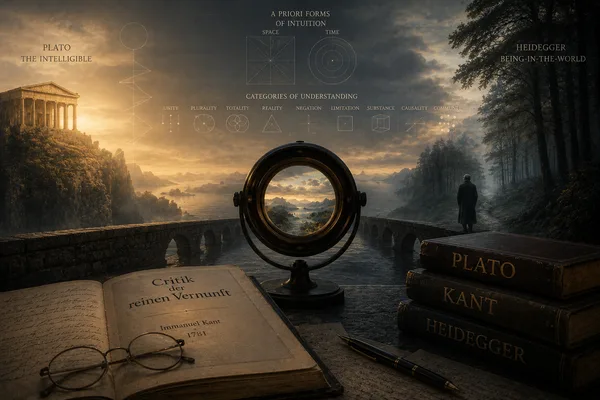
Kant as the Bridge from Plato to Heidegger

Plato and the Long Argument Over Idealism

We spend all day trying to appear reasonable and in control. Then we fall asleep and carry a fish tank through an airport while our childhood dentist explains the stock market.
Examine attention as a cultivated virtue across work, art, domestic life, and study.
Lens: Virtue ethics and phenomenology of noticing
Argue for slow learning as resistance to shallow consumption. Use craft, reading, brewing, photography, and writing as examples.
Lens: Philosophy of education and attention economy critique
Conan O'Brien's comic dislike of portals in movies, understood as cheap exits from difficult plot problems, turned inward: people may also use portals in the movies of their own lives. Foods such as In-N-Out cheeseburgers, delivery pizza, and other stereotypically bad-for-you meals can be more than nutritional events. They may reopen an earlier emotional world or summon a recognizable version of the self. These rituals may feed something archetypal: a stereotyped but partly autonomous figure that may belong to Jung's collective unconscious—or may simply behave as if it does when carefully described by a phenomenologist.
Lens: Jung, archetypes, complexes, phenomenology, ritual, memory, identity, nostalgia, liminality, ordinary life
Explore stewardship as the care of what is near: home, tools, work, body, projects, relationships, and inherited institutions.
Lens: Ethics of care, scale, and attention
Explore maintenance as moral and practical work. Contrast repair and upkeep with novelty and replacement.
Lens: Philosophy of repair and critique of disposability
Let's make that bridge essay, this will be an interesting read. Let's also instruct cursor to help make this bridge within the Shelf. Kant as the bridge from Plato's upward movement toward the intelligible to Heidegger's question of world-disclosure. Scholarly but readable; no fake citations.
Lens: Kant, Plato, Heidegger, Transcendental Idealism, Synthetic A Priori, Phenomenology, Metaphysics, German Idealism, Philosophy of Experience
Write a thoughtful, accessible lunch-break essay on dreams as the night shift of the soul: biblical dreams (Joseph, Pharaoh, Nebuchadnezzar, Jeremiah on false dream-prophets), Freud on disguised wish-fulfillment, and Jung on compensatory symbolism. Theme: dreams humiliate pride — the ego is not master of its meaning. Warm, lightly philosophical, funny where appropriate, no academic tone, no fake citations.
Lens: Dreams, Bible, Freud, Jung, pride, psychology, philosophy
Let's now craft one more for me, something new-to-me. Heidegger. Let's write something scholarly in the sense that it fits in with the narrative of Philosophy, but also make it interesting in a creative way. Connect to the Plato and Kant thread on the Shelf. No fake citations.
Lens: Heidegger, Plato, Phenomenology, Being and Time, Metaphysics, Technology, Art, Truth, Modernity, Idealism
Explore Idealism as it has been explored by real philosophers since the ancients, including its opposition, with Plato as a thread throughout from the ancients up to modern Jung and Tarnas. Serious but readable; educational rather than motivational. No fake citations.
Lens: Plato, Idealism, Materialism, Kant, Hegel, Jung, Richard Tarnas, Western philosophy
Write an essay on how shame becomes envy, how envy finds a crowd, and how the theory of the monster risks becoming monstrous itself. Move from Cain and Abel through biblical valleys of shame, Freud’s envy of potency, Jungian shadow and collective psychology, and the institutional forms of scapegoating—toward a humane recognition that refuses the narcotic relief of a common enemy.
Lens: shame, envy, collective psychology, Jung, Freud, biblical symbolism, archetypes, scapegoating
Einstein's Theory of Relativity. At a certain point in his life, he met with Jung, and they delved into various concepts, one being Synchronicity. We can flesh out a bit of these concepts as well as draw a picture of how other concepts like time-travel, have branched from this thought. Should we also add some information about the electromagnetic spectrum, specifically the speed of it: the speed of light, to tie some of this together — in regard to the concepts these thinkers had at the time?
Lens: Einstein, Jung, Pauli, relativity, synchronicity, time, light, electromagnetic spectrum, time travel, modernity