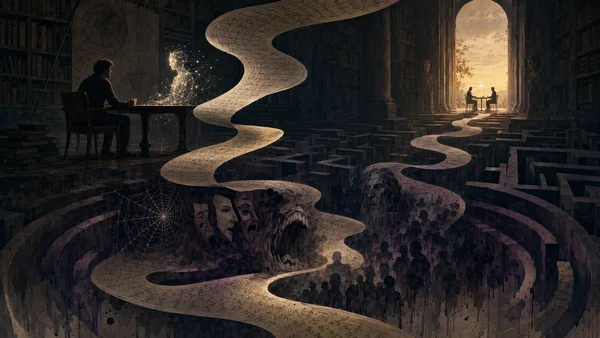
When Time Became Strange
Einstein, Jung, and the Search for Meaning in a Universe Without a Master Clock
- Einstein
- Jung
- Pauli
Einstein did not make time mystical; he made it less obedient to common sense. Jung’s synchronicity was not a consequence or proof of relativity, but it arose within the intellectual atmosphere relativity helped create—an atmosphere in which the visible world, the universal clock, and mechanical causality no longer seemed sufficient descriptions of reality. The careful bridge between them is Wolfgang Pauli, and the enduring subject is not whether coincidence is secretly physics, but how human beings search for meaning once time itself has ceased to be simple.
There is a kind of coincidence that seems to change the pressure in a room. You think of someone you have not spoken to in years, and their name appears on your phone. A symbol from a dream turns up the next afternoon in an unexpected place. A missed train, irritating in the moment, alters the course of a day and leads to an encounter that feels improbably exact. Such events may be statistically ordinary. Given enough days, enough people, and enough wandering thoughts, unlikely combinations must eventually occur. Yet this explanation does not quite describe the experience. The event does not merely happen. It seems, for a moment, to arrive.
Carl Jung gave this unsettling category of experience a durable name: synchronicity. He used the term for coincidences in which an inner event and an outer event appear meaningfully related without an identifiable causal chain joining them. A dream does not physically manufacture the beetle that appears at the window; the beetle does not travel backward in time to cause the dream. Nevertheless, dream and event seem to rhyme. Their relationship is not mechanical but symbolic.
The idea has always attracted two kinds of excess. Its devotees can turn every accident into a telegram from the universe. Its critics can dismiss the whole subject by observing, correctly, that human beings are pattern-making animals with selective memories. Jung’s notion is most interesting between those reactions. A coincidence need not prove that the cosmos has singled us out in order to become psychologically important. The first serious question is not, “Did the universe send this?” It is, “Why did this event acquire such power over my attention?”
To understand why Jung thought this question might reach beyond ordinary psychology, however, we should begin somewhere unexpected. We should begin with light.
The Narrow Window
By the beginning of the twentieth century, physics had already made the visible world feel provincial. What human beings call light is only a narrow portion of the electromagnetic spectrum. Radio waves, microwaves, infrared, visible light, ultraviolet, X-rays, and gamma rays are not separate species of magic; they are regions of electromagnetic radiation distinguished by wavelength and frequency. The human eye detects only a small interval. A radio receiver and an X-ray detector disclose other regions of the same physical reality.
That familiar diagram of the spectrum contains a quiet philosophical shock. The world is not identical with what appears to us. Our eyes do not give us reality whole; they give us the portion to which a particular animal became receptive. We live inside a biological window and, until an instrument widens it, easily mistake that window for the landscape.
Einstein’s revolution went further. Light was not merely one inhabitant of a reality larger than vision. Its speed in a vacuum appeared to remain the same for inertial observers regardless of their relative motion. Today that speed is defined exactly as 299,792,458 meters per second. The number is easy to recite and extraordinarily difficult to absorb.
If a passenger throws a ball toward the front of a moving train, an observer beside the tracks can combine the speed of the train with the speed of the ball. Ordinary velocities add. Light refuses this arrangement. The observer on the train and the observer beside the track do not rescue common sense by assigning light two conveniently different speeds. Instead, their measurements of distance and duration must differ.
This is the hinge of special relativity. If the laws of physics are the same in inertial frames, and if the speed of light is invariant, then space and time cannot remain the rigid background that Newtonian intuition expects. Moving clocks can disagree. Lengths depend upon the state of motion of the observer. Most disturbingly, distant events judged simultaneous in one frame need not be simultaneous in another.
Einstein did not show that time is imaginary, subjective, or freely invented. He showed something more disciplined: measurements of time are inseparable from physical relations among observers, signals, motion, and events. Relativity did not dissolve the clock. It removed the clock from God’s wall.
The old intuitive picture had imagined time as a river through which the entire universe moved together. Every star, body, and thought occupied the same universal “now,” even if no observer could see the whole arrangement. Relativity replaced that invisible master current with spacetime—a structure in which there is no single, observer-independent division of all events into past, present, and future. Time remained lawful, measurable, and real. But it became local.
This distinction matters because the popular imagination often hears the word relative and translates it as arbitrary. Nothing in Einstein licenses that move. Relativity is not an escape from rigor but one of rigor’s great victories. The theory limits what an observer may claim and specifies how different observations are related. It is precisely because the equations are severe that their consequences are strange.
Dinner with Einstein
Jung encountered this new picture of time not merely as an item in the newspaper but through Einstein himself. The two men met in Zurich during the years before the First World War, when Einstein was teaching there and sometimes dined at Jung’s home. Decades later, Jung recalled listening as Einstein explained relativity and credited those conversations with beginning a line of thought about the possible relativity of time and space for the psyche. He also made the chronology clear: the later, more sustained path toward synchronicity ran through his relationship with the physicist Wolfgang Pauli.
This history is suggestive, but it is easy to overstate. Einstein and Jung did not jointly develop synchronicity. Einstein did not offer a physical explanation of meaningful coincidence, and relativity contains no hidden psychological doctrine. His role was catalytic. He helped make time newly thinkable.
That may sound modest, but changes in thought often travel this way. A scientific theory can be technically confined to one domain while altering the metaphors available to an entire culture. Darwin’s biology changed how novelists imagined family and inheritance. Industrial machinery changed how psychologists described the mind. Computers later supplied the language of information, memory, processing, and code. The borrowed metaphors are never identical to the science that inspired them. They can illuminate or mislead. But they reveal how a discovery changes more than the field in which it was made.
Relativity made it harder to regard ordinary human intuition as the court of final appeal. Time and simultaneity—apparently the most obvious furniture of existence—were not what they seemed. Jung, whose psychology was already devoted to dreams, symbols, myth, and the autonomous behavior of the unconscious, recognized the intellectual opening. If conscious perception gave only a partial view of the psyche, and the senses gave only a narrow view of nature, perhaps causality too was not the only form of order worth considering.
Here the analogy becomes dangerous. It should. The interesting bridges between disciplines are rarely safe enough to cross without looking down.
Physics studies relations that can be mathematically formulated and publicly tested. Jung studied experiences whose force often depends upon an individual life: a private dream, a charged symbol, a coincidence arriving at a moment of crisis. The first seeks results independent of personal meaning. The second begins with the production of meaning. To pass carelessly from one to the other is to confuse two kinds of explanation.
Yet refusing the bridge altogether would also miss the historical drama. Einstein had shown that the commonsense account of time was incomplete. Jung wondered whether the commonsense account of connection might be incomplete as well.
Pauli at the Border
Wolfgang Pauli is what prevents this story from becoming a charming but shallow anecdote about two famous men at dinner. Pauli was one of the formidable physicists of his generation, a Nobel laureate whose exclusion principle became fundamental to quantum physics. He was also psychologically troubled, intellectually severe, and unusually receptive to the symbolic material of his dreams.
Pauli began analysis with one of Jung’s associates in the early 1930s, and Jung later used a large sequence of his dreams in Psychology and Alchemy. Their subsequent correspondence became a long, difficult conversation between physics and depth psychology. ETH Zurich describes the exchange as an attempt by two leading figures to seek common ground between their disciplines; Jung’s engagement with physics moved from relativity toward synchronicity, while Pauli’s encounter with Jungian thought informed his reflections on symmetry and complementarity.
Pauli did not simply certify Jung with the authority of modern physics. That interpretation diminishes them both. He questioned Jung’s formulations, pressed for greater precision, and shared an interest in whether mind and matter might be partial descriptions of a deeper order. Their dialogue did not produce an accepted scientific theory joining psyche and nature. It produced something rarer and perhaps more honest: a sustained attempt to think at a border without pretending the border had disappeared.
Jung called synchronicity an “acausal connecting principle.” The phrase was ambitious. He proposed that some inner and outer events might be joined by meaning rather than by the transfer of physical force. In the famous clinical example, a patient recounts a dream about a golden scarab while a scarab-like beetle appears at the window. Jung catches it and presents it to her. The coincidence breaks through an intellectual resistance in the analysis. Whatever we make of the event metaphysically, its psychological action is clear: it reorganizes the moment.
This is the strongest level at which to approach synchronicity. A synchronistic event is first an event in lived time. Clocks measure equal seconds, but human beings do not inhabit equal seconds. Five minutes awaiting medical news do not resemble five minutes spent washing dishes. A childhood summer can occupy more memory than an adult year. A smell can collapse three decades. A dream can arrange an entire life into a handful of images. And a coincidence can make an instant feel vertical, as if time has briefly acquired depth.
Physics does not need to deny any of this, because physics is not obliged to describe every level on which time matters. Psychological time is not an alternative measurement system competing with an atomic clock. It is the form time takes within a life.
The error begins when one level is recruited as proof of the other. Relativity does not establish synchronicity. Quantum mechanics does not show that a dream summons an insect. The strangeness of nature is not a blank check for whatever strangeness we would like to believe. Pauli’s presence in the story is valuable precisely because he understood both the attraction of a unified picture and the standards that such a picture would have to survive.
The Modern Imagination Learns to Loop
Even without validating Jung, relativity transformed the cultural imagination of time. Once time belonged to the geometry of spacetime rather than flowing invisibly behind it, the old fantasy of time travel acquired new machinery. General relativity allowed physicists and philosophers to discuss spacetime geometries containing closed timelike curves—paths that return to an earlier point in spacetime while the traveler remains locally below the speed of light. These solutions do not provide instructions for building a time machine. They show that the equations permit structures far stranger than the universal river imagined by common sense.
Science fiction translated that geometrical disturbance into emotional form. Its time machines, loops, branching histories, and messages from the future are rarely about physics alone. They are machines for approaching regret. A traveler wants to prevent a death, revisit a love, repair an origin, or discover whether a life was chosen or already waiting. The mechanism may be spacetime, but the fuel is grief.
This is where time travel and synchronicity touch without becoming the same idea. Both answer a modern suspicion that events may possess an order other than simple succession. In a time-travel story, the later event may help produce the earlier one. In a synchronistic experience, two events appear bound by a shared meaning rather than a visible cause. One is a narrative elaboration of physical possibility; the other is a psychological and metaphysical proposal. Both resist the flatness of “one thing after another.”
They also expose the same desire. Human beings do not merely want more time. We want time to form a pattern. We want the missed train, the recurring dream, the old mistake, and the sudden encounter to belong to one intelligible shape. Causality tells us how one event produces another. Narrative tells us what the sequence means. Synchronicity is Jung’s most controversial attempt to imagine a point at which those orders might meet.
No Master Clock
The temptation at the end of this story is to force a verdict. Either synchronicity must be promoted into a law of nature or reduced to coincidence plus cognitive bias. But the phenomenon can remain worthy of thought even when the metaphysical question stays open.
Skepticism performs an essential service. With enough opportunities, improbable events become probable. We remember the dream that appears to come true and forget the hundreds that do not. We notice the repeated number after it has become emotionally important. The mind edits, selects, and completes patterns. Any responsible discussion of synchronicity must preserve these explanations.
But explanation is not always exhaustion. To explain why music produces a bodily response is not to have heard the song for someone else. To identify the cognitive mechanisms that intensify a coincidence does not yet tell us what place the event will take in a person’s life. A coincidence may have no supernatural cause and still become a genuine turning point. Meaning is not rendered counterfeit simply because it cannot be weighed.
Einstein and Jung therefore belong together most fruitfully as a contrast. Einstein describes a universe in which time is relative but rigorously lawful. Jung describes a psyche in which time is measured not only in duration but in significance. Einstein removes the universal clock; Jung asks what remains when a life cannot be understood by clocks alone. Pauli stands between them, guarding the possibility of dialogue and the danger of confusion.
The electromagnetic spectrum offers a final image, provided we keep it an image rather than mistake it for evidence. Visible light is real, indispensable, and radically incomplete. It is the narrow band in which a human eye meets a much larger field. Clock-time may be similar in one limited respect. It is real, indispensable, and incomplete as a description of human existence. Beyond it lie biological time, dream time, remembered time, narrative time, and the strangely concentrated time of a meaningful coincidence.
This does not mean that hidden wavelengths carry messages meant for us, or that psychic time bends spacetime. It means only that an instrument can be exact within its purpose without measuring everything that matters.
Einstein did not make time mystical. He made it less obedient to intuition. Jung did not prove that the universe speaks in coincidence. He gave a name to those moments when the world and the psyche seem, however briefly, to use the same symbol. Pauli did not solve the relation between them. He showed what intellectual seriousness at the boundary might look like.
The clock never stopped ticking. It simply ceased to be the whole story.
And behind its face—behind the hands, the numbers, and the measured succession of one moment after another—modern thought found light, motion, memory, dream, and the possibility that time can be exact without ever being simple.
Summary
Einstein did not make time mystical. He made it less obedient to common sense. Relativity broke the old picture of one master clock ticking behind the universe; Jung then asked whether the moments of a human life might be joined not only by cause, but sometimes by meaning.
Seed Prompt
When Time Became Strange
SeedEinstein's Theory of Relativity. At a certain point in his life, he met with Jung, and they delved into various concepts, one being Synchronicity. We can flesh out a bit of these concepts as well as draw a picture of how other concepts like time-travel, have branched from this thought. Should we also add some information about the electromagnetic spectrum, specifically the speed of it: the speed of light, to tie some of this together — in regard to the concepts these thinkers had at the time?
Intended lens: Einstein, Jung, Pauli, relativity, synchronicity, time, light, electromagnetic spectrum, time travel, modernity
Created by: The Shelf editorial team
Sources
- Relativity: The Special and the General TheoryLocated
Albert Einstein
Primary work for Einstein’s account of relativity; retained in the editorial record without a public URL.
- Synchronicity: An Acausal Connecting PrincipleLocated
C. G. Jung
Jung’s principal statement of synchronicity as an acausal connecting principle.
- The Interpretation of Nature and the PsycheLocated
C. G. Jung and Wolfgang Pauli
Primary collaborative volume on the border between Jungian psychology and physics.
- Atom and Archetype: The Pauli/Jung Letters, 1932–1958Located
C. G. Jung and Wolfgang Pauli
2001
Primary Jung–Pauli correspondence (1932–1958). Distinct from the publisher’s editorial introduction PDF listed separately.
- Introduction to the Electromagnetic SpectrumLocated
NASA Science
https://science.nasa.gov/ems/01_intro/
Electromagnetic energy from radio to gamma rays; visible light as the narrow portion detectable by the human eye.
- CODATA Value: Speed of Light in VacuumLocated
National Institute of Standards and Technology
https://physics.nist.gov/cgi-bin/cuu/Value?c
Defines the speed of light in vacuum as exactly 299,792,458 meters per second.
- Atom and Archetype — Publisher’s Introductory MaterialLocated
C. A. Meier (ed.) / Princeton University Press
2001
https://assets.press.princeton.edu/chapters/s7042.pdf
Editorial introduction (not the correspondence): reproduces Jung’s recollection that conversations with Einstein started him thinking about the relativity of time and space, and identifies Pauli as the later path toward synchronicity. See the book entry for the letters proper.
- Wolfgang Pauli and Carl Gustav JungLocated
ETH-Bibliothek
ETH account of the Pauli–Jung correspondence and mutual influence between physics and depth psychology.
- Time Travel and Modern PhysicsLocated
Stanford Encyclopedia of Philosophy
https://plato.stanford.edu/entries/time-travel-phys/
Closed timelike curves and the distinction between theoretical allowance in general relativity and a practical method of building a time machine.
Editorial Note
Sources listed in the Source Cabinet have been located for further reading. Full citation review has not been completed; treat historical and scientific claims with appropriate caution.
Other published essays in Philosophy & Stewardship.