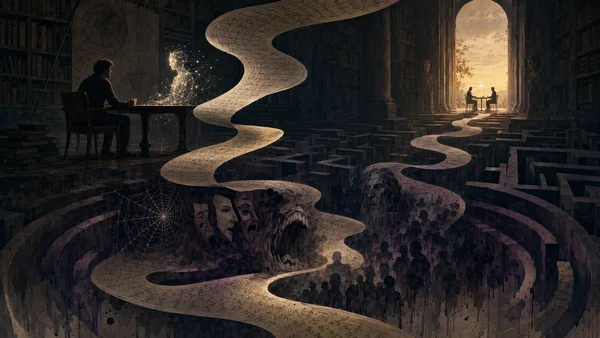
The Shape Behind the World
Plato and the Long Argument Over Idealism
- Plato
- Idealism
- Materialism
Idealism is the recurring philosophical suspicion that reality is shaped by something more intelligible than matter alone. Its opponents keep it honest by demanding contact with bodies, evidence, nature, and ordinary experience.
There are certain thoughts that do not go away. They can be defeated in one century, mocked in another, translated into new vocabulary, dressed in theology, stripped down by science, psychologized, secularized, and called childish. Then, when the argument appears finished, they return by a side door.
Idealism is one of those thoughts.
At its shallowest, the word sounds like optimism. To be an idealist is to be impractical, hopeful, soft around the edges, loyal to what ought to be rather than what is. But that is not what the philosophical tradition means by Idealism. Philosophical Idealism is stranger, harder, and more dangerous. It is the suspicion that the visible world does not fully explain itself. It is the claim, in one form or another, that mind, form, reason, spirit, idea, category, symbol, or archetype belongs not merely to our opinions about reality, but to reality’s very structure.
The opposite suspicion is just as powerful: perhaps the world is matter all the way down. Perhaps what we call beauty, justice, form, soul, purpose, or meaning is something human beings add afterward. Perhaps we are not discovering the shape behind the world, but projecting shape onto a world that has none.
Western philosophy has been turning between these two suspicions for more than two thousand years. It is not a polite academic disagreement. It is one of the main engines of intellectual history.
And Plato is there from the beginning.
Plato is sometimes called an idealist, but that label can mislead if we imagine him saying that reality is “in our heads.” Plato’s Ideas, or Forms, are not private thoughts. They are not moods, preferences, or mental pictures. They are closer to objective realities: Beauty itself, Justice itself, Goodness itself, the Triangle itself. The things we see are changeable and imperfect; the Forms are stable and intelligible. Contemporary discussions of Platonism often describe such abstract objects as non-spatial and non-temporal, not located in the ordinary physical world, yet not reducible to human invention.
This is the first great Platonic wager: what is most real may not be what is most visible.
A beautiful face changes. A just city decays. A drawn triangle is always slightly crooked. A brave action may be mixed with vanity. A musical performance contains mistakes. Yet we still recognize beauty, justice, triangularity, courage, and harmony. In fact, we often judge the visible thing by some invisible standard. The face is beautiful insofar as it participates in Beauty. The law is just insofar as it participates in Justice. The drawn triangle is only intelligible because we already understand what a triangle is supposed to be.
That last phrase is where Plato becomes difficult: “supposed to be.” Supposed by whom? By us? By language? By custom? By God? By mathematics? By the structure of reality?
Plato’s answer is that the world we encounter through the senses is not the deepest layer of the real. The senses give us becoming: this thing appearing, aging, moving, failing, passing away. But the intellect reaches toward being: what the thing is, what makes it intelligible, what does not merely flicker across the surface. The Form is not one more object inside the world. It is what allows objects to be understood at all.
This is why Plato remains so hard to kill. Even people who reject his metaphysics often continue to live inside his question. We still ask whether there is such a thing as justice beyond law. We still distinguish beautiful things from beauty as such. We still know that every drawn circle fails the concept of circle. We still treat mathematics as if it discovers something rather than merely inventing a game. We still feel, in the presence of certain works of art, that the object is not merely an object. Something shines through it.
The opposition begins almost immediately.
Aristotle, Plato’s student, does not simply throw form away. He brings it down to earth. For Aristotle, physical things are compounds of matter and form, a doctrine later called hylomorphism. A bronze statue is not bronze alone, because bronze without shape is just material. But neither is the statue a separate Form floating in another realm. Its form is in the thing. Aristotle keeps Plato’s seriousness about intelligibility while resisting Plato’s separation of the intelligible from the sensible.
This is one of the great philosophical corrections: do not flee the world too quickly. The form of a horse is not hiding in heaven while horses stumble around below as poor copies. The form of a horse is active in the living animal, in its organization, its motion, its development, its way of being a horse. Aristotle gives us a more embodied metaphysics. Plato looks upward; Aristotle looks into the thing.
Then comes the harder opposition: the atomists, and later Epicurus. Here the challenge is not merely to relocate Forms, but to dismiss transcendent Forms altogether. The ancient atomists proposed that nature could be explained through indivisible bodies, void, arrangement, and motion. Epicurus later developed a radical materialism that dispensed with Platonic Ideas or Forms, partly to free human beings from fear of divine punishment and death.
This opposition deserves respect. Materialism is not merely a refusal of wonder. It has its own austerity, even its own beauty. It says: do not multiply invisible worlds when the visible one is already difficult enough. Do not explain thunder by Zeus, disease by demons, or moral confusion by metaphysical fog. Look carefully. Weigh things. Test them. See what matter does.
The materialist is often the cleaner thinker. He cuts away decoration. He distrusts incense. He asks what happens when the poem is over and the body is still hungry. He asks whether justice is anything more than arrangements of power, whether beauty is anything more than nervous-system response, whether the soul is anything more than the body talking to itself.
Idealism needs this pressure. Without it, Plato becomes lazy. Forms become abstractions piled on abstractions. Spirit becomes a word used to avoid detail. Archetype becomes a decorative label for vibes. The opponent is not the villain of the story. The opponent is what prevents Idealism from becoming wallpaper.
Still, the Platonic suspicion keeps returning because materialism also has its temptation: reduction. Once you discover that a thing has parts, you may begin to think it is nothing but its parts. A song becomes air pressure. A face becomes tissue. A promise becomes chemical reinforcement. A cathedral becomes stone. A dream becomes neural discharge. Each reduction explains something real. But each also risks explaining away the thing we were trying to understand.
A melody is made of vibrations, yes. But the melody is not exhausted by the physics of vibration. A sentence is made of marks, but grammar is not ink. A chess game is made of wooden pieces moving on squares, but the game is not lumber. Form is not an optional luxury added after matter. In ordinary experience, form is the difference between a pile and a house, a noise and a song, a movement and a gesture.
This is where Plato survives even inside ordinary life. He survives whenever we say, “That is not what it really means.” He survives whenever the surface is present but the essence is missing. A corporate apology may contain the form of apology without apology itself. A building may contain expensive materials without beauty. A person may obey the rule without being just. We are constantly distinguishing appearance from form, copy from original, instance from standard.
The Christian and Neoplatonic traditions gave Plato another life. The Forms could be understood not as independent entities in a separate metaphysical warehouse, but as divine ideas: patterns in the mind of God. Augustine, Pseudo-Dionysius, medieval theologians, and later Christian Platonists all found ways to treat the visible world as meaningful because it was created through intelligible order. The world became not only matter, but sign.
This religious transformation matters because it changes the emotional weight of Idealism. Plato’s Forms are no longer just metaphysical principles. They become providence, logos, divine wisdom, sacred order. The visible world becomes readable. Nature is a book. Beauty is a clue. The soul is not merely trapped in matter but addressed through matter.
Modernity breaks that enchanted confidence.
The scientific revolution does not simply defeat Idealism, but it does embarrass many inherited versions of it. Nature becomes measurable in a new way. The telescope and microscope expand the visible world beyond human proportion. Mathematics, once friendly to Platonism, becomes the language of mechanism. The universe grows larger and colder. Causes become efficient rather than final. To explain something increasingly means to describe the forces that produce it, not the purpose toward which it tends.
But here the story twists. Modern philosophy does not merely become materialist. It also becomes more intensely concerned with the mind.
Descartes makes consciousness central. Locke examines ideas. Berkeley goes further and argues for a form of idealism in which reality consists of minds and their ideas. Berkeley’s system is often summarized by the phrase “to be is to be perceived,” though his actual view depends on God as the sustaining perceiver, not merely on individual human perception. The Stanford Encyclopedia of Philosophy describes Berkeley as famous for defending the view that reality consists exclusively of minds and their ideas.
Berkeley is easy to caricature. The common joke is that he denies tables and stones. But the deeper point is not that the world is fake. It is that matter, conceived as something totally independent of perception, may be an unnecessary abstraction. We never encounter “matter” naked. We encounter color, pressure, extension, resistance, taste, sound, expectation, coherence. Berkeley asks whether the material substratum is doing any real philosophical work, or whether it is a ghost invented to make common sense feel secure.
Then Kant changes the argument completely.
Kant is not Plato. He does not simply restore the Forms as metaphysical realities beyond the world. Instead, he asks what must be true of the human mind for experience to be possible at all. Space and time, for Kant, are not simply objects we find lying around in the world. They are forms of intuition: conditions under which anything can appear to us. The categories of understanding structure experience as experience. Kant’s transcendental idealism claims that we know objects as appearances, not as things-in-themselves independent of the conditions of human cognition.
This is one of the most important turns in the entire history of Idealism. Plato’s Forms are not simply moved into the mind, but something Platonic has happened. The structure behind experience is no longer located in a separate realm of being; it is found in the conditions of knowing. The world as we experience it is not raw reality stamped directly onto the soul. Experience is already shaped.
Kant gives Idealism discipline. He does not say we invent the world however we please. He says that the world available to us is always already filtered through the basic architecture of human cognition. This is not fantasy. It is a limit. We do not stand outside our own knowing in order to compare the world-as-it-appears with the world-as-it-is-in-itself. We are inside experience, asking what makes experience possible.
After Kant, German Idealism becomes more ambitious. Fichte, Schelling, and Hegel radicalize the question. If the mind contributes the structure of experience, how far does that go? Is nature itself intelligible because it is, in some sense, continuous with mind? Is history merely a sequence of events, or does reason unfold through conflict, contradiction, and development? The Internet Encyclopedia of Philosophy summarizes German Idealism as a movement that transformed Kant’s more modest transcendental idealism into more expansive forms of absolute idealism.
Hegel is the intimidating figure here, and also the one most easily ruined by summary. For our purposes, the crucial move is this: Hegel makes Idealism historical. Truth is not merely a static Form above the world. It unfolds through the world. Consciousness develops. Societies develop. Freedom becomes explicit through struggle. Contradiction is not just a mistake in thinking; it can be the engine by which thought and history move.
With Hegel, Plato’s vertical ladder becomes a historical drama. Instead of the soul ascending from shadows toward the Form of the Good, spirit moves through time toward fuller self-understanding. The cave becomes civilization.
The opposition returns again, this time with even more force. Marx turns Hegel “right side up,” insisting that material conditions, labor, class, and economic structures drive history more decisively than ideas do. Darwin explains the living world without appealing to fixed essences. Freud uncovers unconscious motives beneath civilized ideals. Nietzsche suspects that our highest truths may be sublimated drives, resentments, acts of interpretation. Science, history, psychology, and politics all press against the idealist temptation to float above the body.
And yet, again, the Platonic question survives.
It survives partly because the human being is not only a body among bodies, but a meaning-making creature. We do not merely register events. We dream them, narrate them, symbolize them, fear them, repeat them, mythologize them. We experience our lives not only as sequences of causes, but as patterns. This is where Jung enters the story.
Jung should not be treated as a simple continuation of Plato. Jung’s archetypes are not Platonic Forms in the old metaphysical sense. They are psychological structures: recurring patterns, images, and tendencies that appear across dreams, myths, religions, and symbolic life. Routledge describes Jungian archetypal patterns as common throughout the human species and connected to an inherited collective unconscious.
Still, the resemblance is too interesting to ignore. Plato says the visible world is shaped by intelligible Forms. Jung says the psyche is shaped by archetypal patterns that precede individual personality. Plato asks why beautiful things seem to participate in Beauty. Jung asks why myths from distant cultures seem to circle the same images: the mother, the shadow, the hero, the old wise man, the trickster, death and rebirth.
In Plato, the Form gives intelligibility to the object. In Jung, the archetype gives symbolic charge to the image. A snake in a dream is not merely a snake. A descent into a cave is not merely a plot point. A flood, a wedding, a king, a child, a double, a dark forest—these things arrive already thick with meaning. They are not allegories we invent after the fact. They behave more like ancient psychic grammar.
This is where Idealism becomes intimate. Plato’s Forms can feel cold: abstract, crystalline, geometrical. Jung’s archetypes are warm, frightening, sometimes embarrassing. They do not live in a perfect heaven. They live in dreams, symptoms, obsessions, fantasies, fairy tales, art, religion, and crisis. They are not clean. They are not always moral. They do not ask permission.
But they restore one Platonic feeling: the sense that experience contains more than its surface.
A dream is made of brain activity, yes. But once again, reduction does not exhaust form. The dream has structure. It stages a drama. It selects images. It exaggerates. It disguises. It repeats what consciousness refuses to know. Whether we interpret Jung literally or symbolically, his work reopens the old question in psychological language: are there deep forms in the psyche that shape human life before we consciously choose them?
Richard Tarnas brings this arc into a late-modern key. His The Passion of the Western Mind presents the development of Western thought from the Greeks through modernity and postmodernity, while Cosmos and Psyche attempts a more controversial archetypal cosmology. Penguin Random House describes Tarnas as a historian and professor of philosophy and psychology, and his work is explicitly concerned with the ideas that shaped the Western worldview.
Tarnas is useful here not because we must accept every claim he makes, but because he understands the drama. The Western mind, in his telling, is not just accumulating theories. It is moving through a deep tension between participation and alienation. The ancient world often experienced cosmos and psyche as meaningfully joined. The modern world gained enormous power by separating subject and object, mind and nature, value and fact. But that separation also produced a kind of homelessness. The world became objectively knowable but existentially mute.
This is the modern wound Idealism keeps touching.
Materialism gave us clarity, medicine, engineering, technology, and intellectual hygiene. It protected us from superstition. It made knowledge public, testable, and cumulative. Any honest essay on Idealism has to say this. The materialist opposition is not a dull villain standing outside the cathedral with a clipboard. It is one of civilization’s great achievements.
But the price of materialism, when it becomes a total worldview, is flattening. The world becomes a sum of objects. Mind becomes an accident. Meaning becomes projection. Beauty becomes preference. Value becomes utility. The soul, if we still use the word, becomes a poetic nickname for nervous tissue.
Idealism returns because human beings do not actually live well inside a flattened world. We can function there. We can buy groceries there. We can build machines there. But we cannot fully recognize our own experience there. We continue to encounter form, pattern, value, depth, and symbolic resonance. We continue to ask whether truth is more than fact, whether beauty is more than taste, whether morality is more than preference, whether consciousness is more than computation, whether dreams are more than noise.
Plato is still standing at the beginning of that question.
He does not stand there as an answer we must accept whole. In fact, perhaps Plato becomes more useful when we stop treating him as a system and start treating him as a pressure. Plato applies pressure to the visible world. He asks: what makes this intelligible? What standard are you using when you judge it? What does the thing participate in? What is the difference between the copy and the real? What is the soul remembering when it recognizes truth?
His opponents apply the counter-pressure. Aristotle says: do not abandon the actual horse for horseness. Epicurus says: do not invent transcendent entities when nature is enough. Berkeley says: do not pretend matter is easier to understand than mind. Kant says: do not confuse the world as experienced with the world as it may be apart from the conditions of experience. Hegel says: do not freeze truth outside history. Marx says: do not forget labor, hunger, class, and power. Jung says: do not imagine consciousness is master in its own house. Tarnas says: do not assume disenchantment is the final maturity of thought.
The argument never ends because both sides are guarding something real.
Idealism guards depth. Materialism guards sobriety. Idealism remembers that the world is intelligible, symbolic, mathematical, moral, and beautiful. Materialism remembers that bodies suffer, causes matter, evidence matters, and reality does not bend itself to our preferred meanings. Idealism without opposition becomes fantasy. Materialism without opposition becomes inventory.
The human task may be to live inside the tension.
A pizza is flour, water, yeast, salt, heat. It is chemistry. Fermentation. Gluten development. Thermal transfer. But a great pizza is also form: proportion, restraint, timing, tradition, the idea of pizza realized in a particular crust. A song is vibration, but also melody. A table is wood, but also design. A city is concrete, but also justice or injustice made visible. A dream is neural activity, but also image and drama. A life is biology, but also pattern.
This is not an argument against matter. It is an argument against the word “just.”
Just atoms. Just neurons. Just chemicals. Just social construction. Just projection. Just myth. Just matter.
The word “just” often announces that thought has stopped too early.
Plato’s old question is not whether we should despise the visible world in favor of an invisible one. That is the cheap Platonism. The better question is whether the visible world is visible because form is already shining through it. Whether matter and meaning are enemies, or whether matter is one way meaning becomes touchable. Whether the world is a mute object onto which mind paints symbols, or whether mind and world meet in patterns neither one simply invents alone.
By the time we arrive at Jung and Tarnas, the Forms have changed names. They are no longer only Forms. They are categories, structures, archetypes, symbolic patterns, historical movements, participatory realities. Some versions are philosophically rigorous. Some are speculative. Some may go too far. But the persistence of the question is itself revealing.
The modern person is supposed to be finished with Plato. We are supposed to have grown out of the cave, out of metaphysics, out of cosmic meaning, out of forms and essences and invisible orders. But then we hear a piece of music and feel that it is not merely sound. We see a cowardly act and know it has failed some standard deeper than convenience. We wake from a dream and feel accused by an image. We look at a triangle drawn badly on a board and understand the perfect triangle it fails to be. We fall in love with an ordinary thing done well and sense that craftsmanship is matter remembering form.
So Plato remains.
Not as a museum figure. Not as a marble bust. Not even as a doctrine.
He remains as the question behind the world: What shape is shining through this?
Summary
Idealism is the recurring suspicion that the visible world does not fully explain itself. Plato begins the thread with Forms; Jung and Tarnas reopen it through archetype, psyche, and the modern hunger for meaning.
Seed Prompt
The Shape Behind the World
SeedExplore Idealism as it has been explored by real philosophers since the ancients, including its opposition, with Plato as a thread throughout from the ancients up to modern Jung and Tarnas. Serious but readable; educational rather than motivational. No fake citations.
Intended lens: Plato, Idealism, Materialism, Kant, Hegel, Jung, Richard Tarnas, Western philosophy
Created by: The Shelf editorial team
Sources
No verified sources yet. This essay is in an early stage and has not been through citation review.
Editorial Note
Part 1 of 3 in the thread "From Plato to the Clearing". Next: The Lens Before the World. This essay has not been through citation review. Sources will appear in the Source Cabinet once located and verified.
Other published essays in Philosophy & Stewardship.