Portals We Walk Through
The ordinary rituals that summon old selves—and perhaps something older
- Jung
- archetypes
- complexes
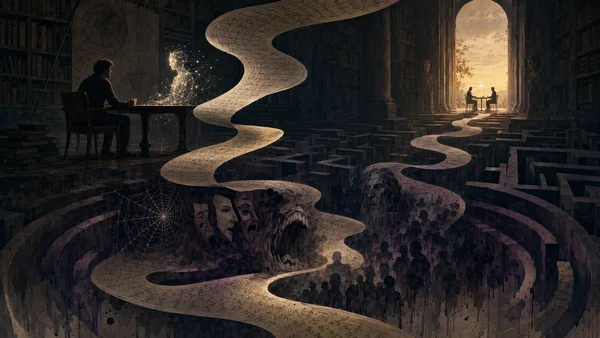
Ordinary objects and rituals can function as psychological portals, summoning patterned versions of human life that feel partly personal and partly inherited. Whether these figures are archetypes, cultural scripts, or metaphysical realities can remain unresolved; wisdom begins by noticing what we are feeding and whether it returns us to life or helps us evade it.
Conan O’Brien once complained that he hates portals in movies. His objection, as I remember it, was not to magic itself. It was to the cheapness of the device: when a story has made a sufficient mess of its own reality, a glowing circle opens and carries everyone somewhere else. The portal does not solve the plot. It excuses the plot from having to be solved.
It is a good comic complaint because it recognizes a real temptation in storytelling. It is also, with only a slight turn, a complaint about human life.
We have portals too. They seldom glow. They arrive as a song, a neighborhood, a certain hour of night. They wait in an old coat, a church pew, a bar where we once knew what to say. Sometimes they are delivered to the door in a cardboard box.
Consider pizza—not the handmade kind whose crust you have tended for three days, but delivery pizza: the reliable circle already cut into portions, its heat softening the cardboard beneath it. Nutritionally, it is a combination of flour, fat, salt, cheese, and sauce. Psychologically, it may be comfort or appetite. Yet neither description quite accounts for what can happen when the box opens.
The room changes. The television wants to be turned on. The lights seem better a little dimmer. Tomorrow becomes less articulate. For some people, the first bite opens onto childhood: Friday night, rented movies, adults briefly relieved of their seriousness. For others, it opens onto the first apartment, when solitude still felt like independence. The pizza has not merely recalled another time. It has helped reconstruct its atmosphere.
An In-N-Out cheeseburger can do the same thing. So can a particular beer, the first cold evening of autumn, or a song heard through cheap speakers. These experiences do not simply remind us who we were. They can summon that person—with his desires, his posture, his vocabulary, and his sense of what happens next.
This is the first meaning of a portal: an ordinary thing through which we enter a patterned world.
The Person Who Arrives
Memory is usually imagined as an archive. We retrieve an image from storage and examine it from the safety of the present. But some memories are less like photographs than rooms. To remember them is already to step inside.
A smell can alter the scale of the body. A song can make an old grief seem unfinished. Returning home for the holidays can reduce an accomplished adult, within minutes, to the exact place he occupied at sixteen. The family has not conspired to perform a ritual, yet the old arrangement appears with astonishing efficiency. Everyone knows where to stand.
The unnerving part is not that we remember an earlier self. It is that the earlier self seems to remember how to become us.
We say that a person “fell back into an old role,” as though the role had been waiting intact. We say, “I don’t know what came over me,” or “I become someone else around him.” Ordinary language is full of small acknowledgments that the self is not a single speaker seated permanently at the center. We contain dispositions, roles, emotional systems, and half-personalities that respond to their proper cues.
Jung called some of these charged formations complexes. A complex is not just a difficult subject or a bad memory. It can behave with enough coherence to seem nearly autonomous. When activated, it gathers perception around itself. Neutral remarks become insults; ordinary setbacks become proof; one appetite becomes the only appetite worth consulting. The complex does not merely enter the person’s thoughts. For a while, it edits the world in which thought occurs.
The portal, then, may be the activating threshold. A phrase, flavor, room, or ritual admits a particular figure and gives it somewhere to sit.
This does not make every pleasure pathological. It makes pleasure more interesting. The question is not simply, “Why do I want this?” but “Who am I when I want it?”
The Stereotype Beneath the Stereotype
The person who eats pizza alone in front of the television is a stereotype. We recognize him instantly because culture has flattened him into an image: the bachelor, the exhausted worker, the mildly defeated man in sweatpants. A stereotype is ordinarily something we impose on other people, reducing a life to a small set of visible traits.
But stereotypes can also be costumes we discover hanging inside ourselves.
Under the contemporary figure of the man with the pizza box, there may be older patterns: the Solitary Feaster, the Exile, the Child Temporarily Free of Supervision, the King in a private court, the Recluse who has withdrawn from obligation. None is a clinical diagnosis, and none provides a code by which the scene can be mechanically decoded. They are names for shapes that experience sometimes takes.
This is where Jung’s idea of the archetype becomes useful—and dangerous if used lazily. An archetype is not merely a famous character type, nor is it a collectible set of labels such as Hero, Mother, Trickster, and Wise Old Man. In Jung’s account, archetypes are underlying forms or tendencies that organize images and behavior. We do not encounter the archetype naked. We encounter its local clothing: a myth, a dream, a celebrity, a family role, a lonely dinner under the blue light of a television.
The stereotype may therefore be the cultural costume of a deeper pattern. “Guy eating pizza alone” belongs to a particular technological and commercial world. Solitude, feasting, regression, exile, and temporary sovereignty do not.
This does not prove that an autonomous Solitary Feaster exists somewhere in the collective unconscious. It suggests a possibility more modest and more difficult to dismiss: human beings repeatedly inhabit recognizable arrangements of desire and meaning, and those arrangements can feel larger than the biographies of the individuals inhabiting them.
We recognize the figure before we understand it. Perhaps that recognition is cultural. Perhaps it is inherited. Perhaps culture is one of the ways inheritance learns to speak.
Feeding the Figure
“Feeding” is an unusually precise word for what happens next.
We feed the body, obviously, but we also feed a mood, an ambition, a grievance, a fantasy. Attention is food. Repetition is food. A private ceremony gives a pattern shelter, furniture, and a schedule.
At first, the ritual serves us. We choose the meal, the record, the chair. With repetition, however, the arrangement begins to request its own conditions. It wants the same food at the same hour. It wants a particular program playing in the background. It may want us alone. It offers arguments on its own behalf: the day was difficult, tomorrow will be better, this is what Friday night is for.
None of those arguments must be false. Autonomy rarely announces itself with nonsense. It recruits perfectly reasonable sentences into a world that has already decided what will happen.
This is why an archetypal interpretation can be more revealing than the language of willpower. Willpower imagines a contest between one stable self and one unwanted behavior. But what if the behavior belongs to a complete personality-state? What if the cheeseburger is not merely desired by the present self but serves as the key to a room in which another self becomes present?
The ritual then feeds more than hunger. It feeds continuity. It assures the figure that its world still exists.
The phenomenon appears far beyond food. A uniform may feed the Officer even after the shift ends. An academic office may feed the Professor until uncertainty becomes intolerable. Social media may feed the Performer, outrage the Avenger, romance the Abandoned Child, spiritual language the Prophet. The point is not that these roles are fraudulent. Many are necessary and honorable. The danger begins when a partial pattern claims the authority of the whole person.
Jung sometimes described this danger as identification or possession: consciousness becomes identified with an archetypal power and mistakes its enlarged voice for the entire self. In less dramatic language, we could say that a role acquires momentum and loses proportion. It starts interpreting everything in its own favor.
What we feed becomes better able to feed itself.
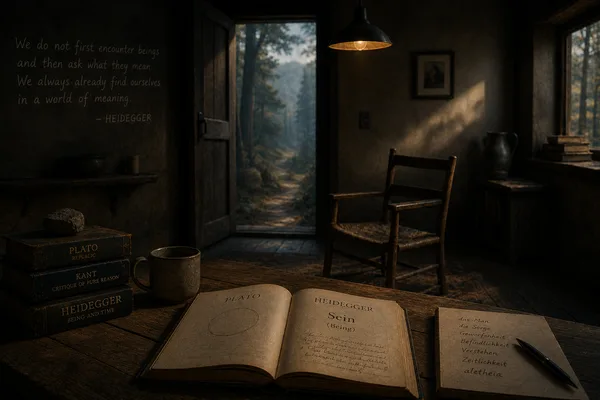
The Phenomenologist at the Door
At this point the essay could make a grand metaphysical claim: archetypes are real, they inhabit a collective unconscious, and ordinary rituals open channels through which they enter us. It is an exhilarating possibility. It may even be true. But declaring it too quickly would make the portal cheap.
Phenomenology offers a more patient method. Before deciding what an experience ultimately is, describe how it appears. Suspend, for a moment, the argument over whether the figure is a neurological association, a cultural script, an inherited psychic form, or an autonomous presence. Ask what changes when the threshold is crossed.
Does time change?
Does the room acquire an atmosphere?
Does a different vocabulary become available?
Do certain desires grow vivid while others become strangely difficult to imagine?
Does the body itself change—its posture, tempo, appetite, or sense of age?
Afterward, do I feel restored, diminished, released, ashamed, or returned?
These are not proofs of metaphysics. They are observations about experience. Phenomenology begins from the first-person structure of consciousness: not only the object before us, but the way the object is given meaning within a lived world. The same pizza can be dinner, celebration, anesthesia, sacrament, nostalgia, or surrender. Its chemical composition remains stable while its human reality changes completely.
This restraint lets us entertain the strangest interpretation without being captured by it. If archetypes are metaphysically real, careful attention may help us encounter them without inflation. If they are inherited patterns of cognition, attention may reveal their operation. If they are cultural performances, attention may show where the script begins. The method remains useful under every explanation.
The phenomenologist stands at the door and notices what the metaphysician is tempted to name.
Thresholds and Rituals
The portal metaphor also belongs to a much older understanding of ritual. Anthropologists studying rites of passage described a threshold condition—liminality—between one social state and another. The initiate has left an old identity but has not yet fully entered the new one. The threshold is not just a line to be crossed; it is a transforming interval.
Our private portals are usually smaller and less ceremonial, but they borrow some of the same architecture. We separate from ordinary time. We enter a bounded atmosphere. We return, ideally, altered.
This helps distinguish ritual from compulsion. A healthy ritual has an exit. The birthday meal ends; the Sabbath returns its participant to the week; the funeral allows the mourner to rejoin the living without pretending the dead never existed. Ritual makes a chamber for an experience that cannot occupy every room.
A compulsive portal is different. It promises transformation but provides only recurrence. We enter and emerge in the same place, except that the pattern is stronger and the present has become slightly less persuasive. It resembles the cinematic portal Conan objected to: an exit from the demands of the plot.
Yet escape is not always cowardice. A difficult life sometimes requires temporary shelter. The Child may need an evening. The Recluse may need silence. The Feaster may remind the disciplined adult that abundance and laughter are not moral failures. A portal can recover capacities that the official personality has neglected.
The important distinction is not indulgence versus restraint. It is return versus evasion.
Does the portal return us to life with something restored? Or does it save us from discovering what the present plot requires?
The Portal That Resembles Home
Nostalgia complicates the answer because the worlds behind our portals often feel like home. But “home” is not always the place where we flourish. Sometimes it is simply the arrangement our nervous system knows best.
We may return to an old relationship dynamic because its pain is legible. We may revisit a period of loneliness because loneliness once protected us from humiliation. We may recreate a family atmosphere in which everyone had a fixed role, not because the role was kind, but because it spared us from uncertainty.
The portal feels true because the figure inside it is familiar. Familiarity then disguises itself as authenticity: This is the real me. This is who I have always been.
But the self who has existed longest is not necessarily the self who should govern.
This is where the archetypal language earns its place. It gives dignity to the figure without granting it sovereignty. The Eternal Child is not merely immaturity; it may carry wonder, renewal, play, and the capacity to begin. The Recluse is not merely avoidance; solitude can protect interior life. The King can establish order; the Lover can restore value; the Wanderer can break a dead allegiance. Every figure brings a gift. Every figure becomes destructive when it persuades us that its gift is the only human good.
To recognize an archetype is not to obey it. It is to develop a relationship with the pattern rather than being unconsciously arranged by it.
Walking Through Awake
Once we begin looking, portals are everywhere.
The first warm day opens the adolescent’s car window. A baseball broadcast opens the grandfather’s porch. A fragrance opens a school hallway. A cheap keyboard tone opens a decade whose technology once seemed futuristic. A family recipe opens a country the cook may never have seen. A beer poured into the right glass opens monasteries, ballparks, neighborhood taverns, and the private history of whoever first handed us one.
We should not close these doors. A life without portals would be trapped in a thin present, cut off from the vertical depth of memory and symbol. The human capacity to let an object contain a world is one of the sources of art, ritual, gratitude, and continuity.
But we can learn to pause at the threshold.
What world is assembling around this act? Which version of me knows this room? What does he want? What does he protect? What gift does he carry? What happens if I let him visit without giving him the house?
Perhaps there are archetypal figures in the collective unconscious, awaiting the images through which they can become visible. Perhaps they are structures carried in the human animal, recurring because bodies, families, dangers, loves, and deaths recur. Perhaps they are stories culture has rehearsed so thoroughly that they now speak with the intimacy of instinct. The phenomenologist need not settle the matter before paying attention.
The figure has arrived. The atmosphere has changed. Something has been fed.
The final question is not whether the portal is real. It is whether we know that we have crossed it—and whether, when the evening is over, we can walk back through awake.
Summary
A pizza box, a song, a familiar room: some things do more than remind us of the past. They seem to open a world—and invite a recognizable figure inside us to take the chair.
Seed Prompt
Portals We Walk Through
SeedConan O'Brien's comic dislike of portals in movies, understood as cheap exits from difficult plot problems, turned inward: people may also use portals in the movies of their own lives. Foods such as In-N-Out cheeseburgers, delivery pizza, and other stereotypically bad-for-you meals can be more than nutritional events. They may reopen an earlier emotional world or summon a recognizable version of the self. These rituals may feed something archetypal: a stereotyped but partly autonomous figure that may belong to Jung's collective unconscious—or may simply behave as if it does when carefully described by a phenomenologist.
Intended lens: Jung, archetypes, complexes, phenomenology, ritual, memory, identity, nostalgia, liminality, ordinary life
Created by: The Shelf editorial team
Sources
- The Archetypes and the Collective UnconsciousLocated
C. G. Jung
1968
Primary Jungian account of archetypes and the collective unconscious underlying the essay’s archetypal framing.
- The Structure and Dynamics of the PsycheLocated
C. G. Jung
Primary source for Jung’s discussions of complexes and psychic autonomy that inform the essay’s portal/complex distinction.
- Liminality and CommunitasLocated
Victor Turner
1969
Turner’s discussion of the threshold phase in rites of passage; grounds the essay’s liminality framing.
- The Collective UnconsciousLocated
Walter Boechat
Concise account of the collective unconscious in Jungian clinical practice.
- PhenomenologyLocated
David Woodruff Smith
https://plato.stanford.edu/entries/phenomenology/
Methodological distinction between describing the structure of lived experience and making a metaphysical claim about its ultimate cause.
- The Rites of PassageLocated
Arnold van Gennep
1960
Foundational three-part structure of separation, transition, and incorporation later developed by Turner.
Editorial Note
Sources listed in the Source Cabinet have been located for further reading. Full citation review has not been completed; treat psychological and historical claims with appropriate caution.
Other published essays in Philosophy & Stewardship.