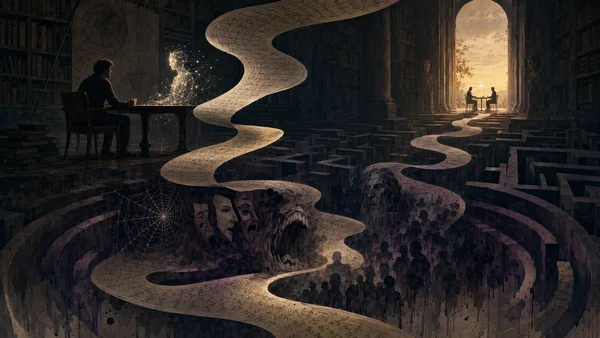
The Night Shift: Dreams, Pride, and the Strange Theater of the Soul
We spend all day trying to appear reasonable and in control. Then we fall asleep and carry a fish tank through an airport while our childhood dentist explains the stock market.
- Dreams
- Bible
- Freud
Dreams do not respect the résumé.
There is something slightly embarrassing about dreams. We spend all day trying to appear reasonable, employable, morally consistent, and at least somewhat in control of our lives. Then we fall asleep and suddenly we are back in high school, late for a final exam in a class we never attended, carrying a fish tank through an airport while our childhood dentist explains the stock market.
Dreams do not respect the résumé.
That may be why human beings have always taken them seriously. Not always literally. Not always wisely. But seriously. Dreams arrive from somewhere beneath the tidy front desk of the mind. They are private, theatrical, symbolic, and often ridiculous. They feel like nonsense, but not random nonsense. They feel like the soul has a basement and somebody down there is rearranging the furniture.
The modern person is tempted to treat dreams as brain static: neurological confetti, midnight screen savers, the mind's junk drawer sorting itself while the body recharges. There is some truth in that caution. Contemporary philosophy and sleep science generally treat dreams as real experiences that occur during sleep, while remaining divided over what purpose, if any, they serve. But if we stop there, we miss the old human drama of dreaming: dreams have always been where pride gets ambushed.
In the Bible, dreams often come to people who are powerful, endangered, inflated, or confused. Pharaoh dreams of fat cows swallowed by thin cows and healthy grain consumed by withered grain; Joseph interprets the dreams as a warning about abundance followed by famine. The dream is not merely a private symbol. It becomes a public warning, an interruption in royal confidence, a message that the future is not impressed by the throne.
That biblical pattern matters. Dreams are not treated as toys for self-fascination. Joseph does not strut into Pharaoh's court as a freelance "dream guy" with a velvet robe and a podcast. He explicitly refuses the pride of interpretation: the answer, he says, is not in him. The dream's meaning is not a trophy for Joseph's cleverness; it is a mercy that arrives from beyond him.
That is the first great dream lesson: the dream may be meaningful, but the dreamer is not automatically the master of its meaning.
The Bible is surprisingly balanced about this. It does not say, "Ignore all dreams." It also does not say, "Every weird dream is divine GPS." Jeremiah warns against false prophets who claim dreams as authority when they are really spreading lies and reckless imagination. In other words, "I had a dream" is not enough. A dream can humble a king, but it can also inflate a fool.
This is where the biblical view becomes more interesting than a simple "dreams are messages" idea. Dreams are dangerous because they can puncture pride, but they can also feed pride. Anyone who has ever awakened from a vivid dream and immediately decided it was obviously about their destiny has stood near that cliff. Dreams can become revelation, but they can also become vanity wearing pajamas.
Nebuchadnezzar is the great biblical case study in dream-pride. In Daniel 4, the king dreams of a vast tree visible to the ends of the earth, sheltering animals and feeding all. Daniel interprets the tree as the king himself, whose greatness has grown too high. The dream becomes a warning: humility is coming, one way or another. Later the king is brought low, and when his reason returns, he praises God and admits that those who walk in pride can be humbled.
That is a remarkable image: a ruler so inflated that only a dream can get past the guards.
And maybe that is still true. Pride is not only the ancient king admiring his empire from the balcony. Pride is also the everyday ego insisting, "I know exactly who I am." Then the dream arrives and says, "Interesting. Then why are you crying in a grocery store built inside your childhood bedroom?"
This is where Freud walks in, cigar smoke and all.
Sigmund Freud did not invent dream interpretation, but he did modernize its scandal. In The Interpretation of Dreams, Freud argued that dreams were not meaningless accidents but disguised fulfillments of wishes. The Freud Museum summarizes this central claim plainly: Freud argues that dreams are wish-fulfillments.
The key word is disguised. Freud's dream is not a clean confession. It is not the unconscious saying, "Hello, here is what you want." It is more like the unconscious trying to sneak through customs with several suspicious suitcases. Freud called the process "dream-work": the mind transforms latent content, the hidden dream-thoughts, into manifest content, the strange dream we actually remember.
This is why Freud remains useful even when he is wrong, excessive, or trapped in the furniture of his own century. He gives us a comic but serious suspicion: perhaps the ego is not the honest narrator it thinks it is. Perhaps the dream is not nonsense. Perhaps it is nonsense with a job.
You dream that your teeth fall out during a work meeting. Freud would not necessarily say, "Ah yes, teeth equal this one universal thing." The pop-Freud version loves decoder rings: snakes mean one thing, trains mean another, staircases mean something that makes everyone uncomfortable. The better Freudian instinct is more personal and more annoying: what does this image do in your mind? What does it conceal? What wish, fear, shame, or conflict has been smuggled into this ridiculous little movie?
Freud's great offense to pride is that he makes the self less transparent to itself. You may think you are a rational citizen of daylight, but at night your wishes put on costumes and perform community theater. The dream says: you are not lying exactly, but you are not telling the whole truth either.
Then Jung enters, less like a detective and more like someone carrying a lantern into a cave.
Carl Jung agreed that dreams mattered, but he pushed away from Freud's narrower emphasis on disguised wish-fulfillment. In Jungian psychology, dreams often compensate for the conscious attitude. The International Association for Analytical Psychology summarizes Jung's view this way: the dream does not simply fulfill an unfulfilled wish; it compensates for the dreamer's waking stance.
That idea is beautiful because it makes dreams less like secret indulgences and more like balance mechanisms. If your waking life becomes too rigid, the dream may become chaotic. If you are too timid, the dream may become grandiose. If you are too certain, the dream may confuse you. If you are too heroic, the dream may hand you a mop.
Jung's dream is not merely a hidden want. It is a message from the neglected side of the psyche. A person who lives only in competence may dream of helplessness. A person who performs kindness while swallowing rage may dream of wolves. A person who thinks he is purely modern may dream in ancient symbols: caves, floods, towers, mothers, kings, shadows, gardens, monsters, fire.
This is where Jung gets fun. He lets dreams be weird without reducing their weirdness too quickly. The dream is not a math problem. It is a symbolic event. A dream image might be personal, but it might also belong to a deeper human pattern. Jung's broader theory of the collective unconscious and archetypes remains debated, but his practical insight still has force: dreams often speak in images older than our opinions.
Freud asks, "What do you secretly want?"
Jung asks, "What part of you has been left out?"
The Bible asks, "Are you humble enough to receive correction, and wise enough not to worship your own dream?"
Those three questions belong together.
The biblical dream humbles pride before God. The Freudian dream humbles pride before desire. The Jungian dream humbles pride before psychic wholeness. Each tradition, in its own way, tells the ego to take a seat. The self is bigger, stranger, and less manageable than the daytime version believes.
This is why dreams are funny. Not joke-funny, although they are often that too. They are funny in the cosmic sitcom sense. A dream has no budget limits and no respect for continuity. Your dead grandfather can appear in a laundromat. Your boss can become a horse. Your apartment can contain a second apartment you somehow forgot about. Dreams operate with the confidence of a bad screenwriter and the emotional precision of a poet.
The absurdity is part of the authority. If dreams were too clean, we would turn them into productivity hacks. We would make a spreadsheet called "Nightly Subconscious Insights." We would ruin the whole thing by Monday.
Instead dreams remain slippery. They resist capture. They ask for interpretation but punish arrogance. The moment you say, "This dream definitely means one thing," the dream seems to grin and grow another hallway.
That humility may be the healthiest way to approach them. Keep a dream journal, but do not become a prophet of your own pillow. Notice recurring images, but do not build a religion around the time you dreamed about a talking raccoon. Ask what the dream reveals, but also ask what your interpretation might be protecting.
A dream can be a warning. A dream can be a wish. A dream can be compensation. A dream can be memory, emotion, fear, indigestion, imagination, or some strange mixture of all of them. The honest interpreter should leave room for multiple layers.
After all, even Pharaoh needed Joseph. Nebuchadnezzar needed Daniel. Freud needed analysis. Jung needed symbols. Nobody gets to be completely self-interpreting.
That may be the deepest reason dreams still matter. They remind us that the human person is not flat. We are not merely schedules, appetites, browser histories, job titles, or opinions. We are layered creatures. We live by daylight, but we are edited at night by forces we do not fully command.
And sometimes, after a long day of being practical, the soul stages a play.
It casts your dentist as a financial advisor. It floods your childhood kitchen. It gives you wings and then makes you late for work. It resurrects old fears, old loves, old embarrassments. It puts a crown on your head and then turns you into an animal until you look up.
The dream is not always sacred. It is not always profound. It is often just strange. But even its strangeness can be a mercy. For a few hours each night, the proud little manager of the self loses the keys to the building.
The night shift takes over.
And in the morning, if we are wise, we do not say, "I have solved myself."
We say, "What was that trying to show me?"
Summary
A lunch-break essay on dreams as the strange theater where pride gets ambushed — from biblical warnings and Joseph's humility to Freud's disguised wishes and Jung's compensating symbols.
Seed Prompt
The Night Shift: Dreams, Pride, and the Strange Theater of the Soul
SeedWrite a thoughtful, accessible lunch-break essay on dreams as the night shift of the soul: biblical dreams (Joseph, Pharaoh, Nebuchadnezzar, Jeremiah on false dream-prophets), Freud on disguised wish-fulfillment, and Jung on compensatory symbolism. Theme: dreams humiliate pride — the ego is not master of its meaning. Warm, lightly philosophical, funny where appropriate, no academic tone, no fake citations.
Intended lens: Dreams, Bible, Freud, Jung, pride, psychology, philosophy
Created by: The Shelf editorial team
Sources
No verified sources yet. This essay is in an early stage and has not been through citation review.
Editorial Note
This essay has not been through citation review. Sources will appear in the Source Cabinet once located and verified.
Other published essays in Philosophy & Stewardship.