The Tide in the Glass
Why beer trends come and go, and why the old styles keep judging us.
- Beer history
- style trends
- and the role of restraint in craft brewing
Beer history does not move in a straight march from old styles to better styles — it moves in tides. Trends reveal desire; pillar styles reveal discipline. The brewer who makes a beautiful pilsner has learned how to stand in the open.
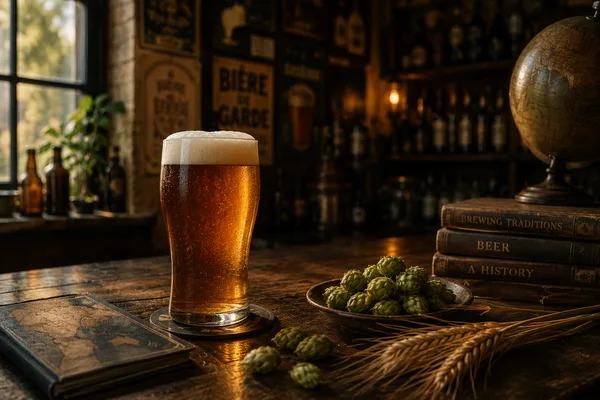
A clean golden beer in a clear glass can look almost anonymous.
No haze. No fruit puree. No lactose. No bourbon barrel. No double dry-hop schedule printed like a guitar pedalboard. No dramatic darkness. No towering adjunct list. Just pale beer, foam, bubbles, bitterness, malt, and the faint promise that the second sip will be better than the first.
This is the trick. The plain-looking beer is often the least plain. A pilsner, helles, bitter, mild, dry stout, or pale ale may seem modest beside the modern taproom's louder inventions, but modesty is not simplicity. Some beers are difficult because they are complicated. Others are difficult because they are exposed.
A hop-forward IPA can be beautiful, electric, resinous, citrusy, tropical, and alive. It can also give the brewer more places to hide. Hops are expressive. Haze can soften edges. Dry hopping can create a curtain of aroma. A big beer can carry a small flaw the way a loud band can survive a missed note. But a clean lager does not have the same mercy. A pilsner does not shout over its flaws. It lets them speak.
This is not an argument against IPA. IPA may be the defining beer of modern American craft for good reason. It gave beer back its voltage. It reminded drinkers that bitterness could be thrilling, aroma could be vivid, and beer did not have to arrive pale, thin, and forgettable. But beer history is not a straight march from old styles to better styles. It moves in tides.
Every age of beer seems to answer the one before it.
Murk to clarity. Sameness to rebellion. Excess to restraint. Novelty to pillars.
The story of beer is not progress. It is recurrence.
Beer With a Thousand Faces
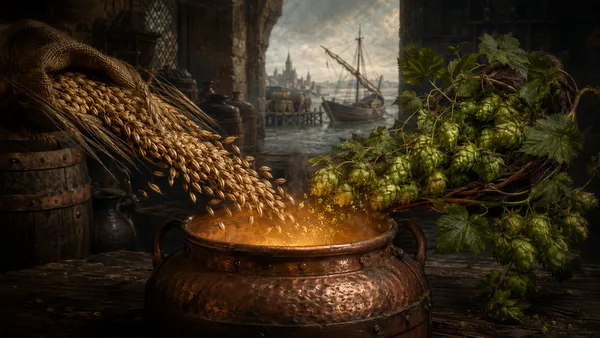
Beer is older than fashion, older than industry, older than the modern idea of a recipe. Before it was divided into styles, ranked on apps, clarified in glass, or sold under fluorescent taproom menus, beer was grain transformed. It was nourishment, ritual, accident, offering, household labor, social glue, and pleasure. Before anyone argued about whether a pilsner should be Czech or German, whether a pale ale should taste of caramel malt or grapefruit peel, whether a stout should be dry or sweet, there was the strange fact that grain and water could become something else.
Beer began not as a style, but as a transformation.
That matters because modern beer talk can sometimes make style feel like the beginning. We say IPA, helles, porter, saison, lambic, Vienna lager, mild, bitter, bock. We act as though these words are fixed containers, each waiting to be filled by a brewer. But style came later. First came place. First came weather, water, grain, time, storage, yeast, vessels, taxes, labor, drinking customs, and whatever a community could make with what it had.
Before style was a choice, it was an answer.
A beer from one region was not different from a beer in another region because someone wanted novelty. It was different because the water was different, the malt was different, the yeast behaved differently, the cellar was warmer or colder, the hops were available or not, the winters were long enough for lagering or not, the local palate wanted nourishment or refreshment or strength or bitterness. The beer that later became "a style" was often a local solution that had become beautiful through repetition.
This is why the old styles still feel alive. Porter is not merely a dark beer. It is London, labor, brown malt, aging, commerce, and the appetite of an industrial city. Saison is not merely peppery farmhouse ale. It is work, season, dryness, refreshment, yeast, and rural necessity turned into elegance. Lambic is not merely sour beer. It is place, patience, microbiology before microbiology had a name. Pilsner is not merely pale lager. It is the drama of clarity, the technological confidence of pale malt and cool fermentation, the dream that beer could be clean, bright, repeatable, and beautiful.
The modern drinker often meets beer style as a menu. The older world made beer style as a consequence.
The Pilsner Problem
Then beer entered industry.
This is one of the great turns in the glass. The brewer became not only a maker of drink, but a manager of scale. Porter belongs here as one of beer history's great urban machines. It was dark, hoppy, aged, and suited to the thirst of London. It was not just a flavor. It was infrastructure. It was vat, city, trade, labor, and distribution. It marked a moment when beer could be produced and consumed at a scale that earlier household brewing could not have imagined.
The industrial brewer did not dream first of novelty. He dreamed of making the same beer twice.
That dream is easy to mock now, especially from inside craft culture, where "consistent" can sound like "boring." But consistency is not the enemy of craft. Consistency is one of craft's hardest achievements. A homebrewer learns this quickly. The first batch is excitement. The second batch is judgment. Can you do it again? Can you control fermentation? Can you keep oxygen out? Can you manage temperature, sanitation, bitterness, carbonation, and time? Can you make the beer you meant to make, not just the beer that happened?
Commercial brewers know this at a more punishing scale. Customers do not merely want one wonderful pint. They want the same wonderful pint next month. They want the beer to travel. They want the taproom pint and the packaged beer to belong to the same family. They want romance, but they also want reliability.
Industrial beer solved real problems. It made beer stable, repeatable, recognizable, and widely available. It turned consistency into a virtue. But every virtue, overextended, becomes a weakness.
The dream of sameness eventually produced a thirst for difference.
IPA as Electric Guitar
Modern craft beer rose as a rebellion against beer that had become too pale in every sense: pale in color, pale in flavor, pale in imagination. The rebellion was not subtle. It arrived with hops, malt, roast, yeast, barrels, fruit, bitterness, haze, acidity, alcohol, and personality. If industrial beer said, "We can make this the same everywhere," craft beer answered, "We can make something unmistakably ours."
IPA became the electric guitar of this revolt.
Cascade, Centennial, Chinook, Citra, Mosaic, Simcoe — hop names became a kind of music theory. Pine, grapefruit, resin, mango, dank, floral, tropical, stone fruit, diesel, berry, citrus. A drinker could read a label and imagine the solo before the first sip. Bitterness became identity. Aroma became branding. A brewery could tell you who it was through its hop schedule.
This mattered. It still matters. The IPA is not some embarrassing adolescence the beer world needs to outgrow. It is one of the most successful acts of modern brewing imagination. It gave beer back its edge. It made beer exciting to people who thought they already knew what beer was. It turned the tap list into a field of possibility.
But every rebellion creates its own uniforms.
After enough IPAs, the once-startling beer can become the expected beer. After enough haze, haze stops feeling like a revelation. After enough fruit, lactose, barrel, vanilla, coconut, maple, dry hop, and pastry logic, the drinker may begin to miss a beer that finishes cleanly. A beer that does not need a paragraph to explain itself. A beer whose highest ambition is not impact, but return.
This is the problem of abundance. When every beer learns to shout, restraint starts to sound radical.
That is where the tide turns.
A culture does this in more than beer. Music moves from polish to rawness and back again. Fashion discovers excess, then rediscovers plain cloth. Interiors become maximal, then spare, then warm again. Food goes from rustic to refined to theatrical to simple. Technology adds features until people crave a single good button. We get tired of what we asked for. We rebel against the rebellion. The loud thing liberates us, then exhausts us. The quiet thing begins to look brave again.
So it is with beer.
Pillar Beers as Calibration Tools
The return to pilsner, helles, rice lager, bitter, mild, pale ale, dry stout, and other quieter forms should not be mistaken for retreat. It is not anti-craft. It may be craft growing up. After a culture proves that it can add, it has to prove that it can subtract. After brewers show that they can create intensity, they begin to ask whether they can create balance. After drinkers learn to chase novelty, they begin to recognize the deeper pleasure of returning to something.
This is where pillar styles matter.
A pillar style is not old because it survived. It survived because it still has work to do.
Pilsner teaches exposure. Helles teaches softness without emptiness. Dunkel teaches malt depth without heaviness. Bitter teaches proportion, drinkability, and the grace of low alcohol. Mild teaches humility. Porter teaches roast, history, and depth. Dry stout teaches dryness inside darkness. Saison teaches yeast expression without chaos. Pale ale teaches hops in conversation rather than conquest. Vienna lager teaches amber balance. Bock teaches strength without sloppiness. Lambic teaches time, place, and surrender.
These beers are not all simple. Some are wildly complex. Lambic is not modest in its demands. Saison can be expressive and unruly. Porter can carry layers of chocolate, toast, caramel, bitterness, and age. But pillar styles share a certain usefulness. They are calibration points. They help the brewer remember what beer can be when it is not chasing the newest form of attention.
For the homebrewer, this can be humbling. A first IPA can feel like a triumph because the aroma leaps from the fermenter and the hops announce themselves before the beer has even matured. A first pilsner, by contrast, may taste like a list of process notes. Too warm. Too sweet. Too much sulfur. Not enough bitterness. Too much oxygen. Thin foam. Rough finish. The beer becomes a mirror. It shows not only what was added, but what was controlled.
For the commercial brewer, the lesson is similar but sharper. A taproom can sell novelty. A can release can sell urgency. A new hop can sell curiosity. But a brewery's quiet beer often tells the deeper story. The pale lager, the helles, the dry stout, the bitter, the house pale ale — these are the beers that reveal whether the brewery has a center. They may not always be the loudest sellers. They may not always photograph best. But they tell the truth.
That truth is not moral superiority. It is technical clarity.
A hazy IPA can be world-class. A pilsner can be dull. A pastry stout can be brilliantly designed. A bitter can be lifeless. Old styles do not deserve worship simply because they are old, and new styles do not deserve suspicion simply because they are popular. Beer is not improved by nostalgia any more than it is improved by novelty alone.
The question is not whether old is better than new.
The question is: what does this beer ask of the brewer?
A hop-forward beer asks: can you create impact? A clean lager asks: can you create balance without disguise? A saison asks: can you invite yeast to speak without letting it ramble? A stout asks: can you make darkness finish dry? A bitter asks: can you make a small beer feel complete? A pale ale asks: can hops and malt still have a conversation? A lambic asks: can you give up control without giving up judgment?
Every style is a question. Trends are questions an era asks loudly. Pillars are questions brewing keeps asking quietly.
The Return of Restraint
That may be the real reason beer styles rise, fade, return, and endure. Trends reveal desire. Pillars reveal discipline.
The modern IPA revealed a desire for intensity, aroma, identity, and revolt. It answered an era tired of sameness. The current return toward lighter, cleaner, more restrained beers reveals another desire: not for blandness, but for poise. Not for less craft, but for craft with less costume. Not for the death of expression, but for expression that knows when to stop.
The tide is not moving backward. It never does. A modern pilsner is not the same thing as an old pilsner. A craft rice lager is not merely an industrial light lager with better marketing. A contemporary bitter is not a museum exercise. These beers return changed because the brewers and drinkers have changed. They come back through the experience of IPA, through the excess of the taproom, through the knowledge of hops, yeast, water chemistry, stainless steel, refrigeration, style guides, competitions, and homebrew forums. The old forms return, but they return carrying the memory of the rebellion.
That is why the best beer culture does not need to choose between IPA and pilsner, novelty and tradition, expression and restraint. It needs both. It needs beers that explore and beers that judge. It needs the electric guitar and the rhythm section. It needs the dazzling solo and the song that still holds together when played quietly.
The danger is not that brewers will make too many IPAs or too many lagers. The danger is forgetting what each beer is for.
Some beers invite spectacle. Some invite repetition. Some beers sell the first sip. Some sell the second pint. Some beers are postcards from the present. Some are letters from the past that still arrive on time.
The brewer who makes a dazzling IPA may understand expression. The brewer who makes a beautiful pilsner has learned how to stand in the open.
And the drinker, if paying attention, can taste the tide.
Beer began as grain transformed. It became local habit, industrial achievement, global product, craft rebellion, and modern identity. It has been food, ritual, labor, commerce, art, and argument. It has hidden flaws and revealed them. It has shouted and whispered. It has followed fashion and outlived it.
The glass in front of us is never only a glass. It is a small tide pool of history.
The foam falls. The bitterness resolves. The malt holds. The next sip waits.
And somewhere beneath every trend, the old styles keep judging us.
Summary
An essay on why beer styles rise, fade, and return — and what the quieter, older forms still demand of the people who make them. Traces the arc from pre-industrial local brewing to industrial consistency to craft rebellion and the current return toward restraint, arguing that pillar styles like pilsner, bitter, and dry stout function as calibration tools that expose process rather than conceal it.
Seed Prompt
The Return of Restraint
SeedBeer styles move in waves. Modern IPAs can be expressive and forgiving, while clean lagers and pilsners reveal flaws. Timeless styles may function as brewing pillars.
Intended lens: Beer history, style trends, and the role of restraint in craft brewing
Created by: The Shelf editorial team
Sources
No verified sources yet. This essay is in an early stage and has not been through citation review.
Editorial Note
This essay has not been through citation review. Sources will appear in the Source Cabinet once located and verified.
Other published essays in Brewing.