The Marriage of Strangers
How Barley Met Hops—and Beer Became Beer
- Beer history
- material culture
- and the commerce of taste
Hops did not become essential to beer because beer logically required them. They became essential because they helped transform a local, perishable grain drink into a durable commodity—and, over time, taught drinkers to regard bitterness as the natural taste of beer.
How Barley Met Hops—and Beer Became Beer
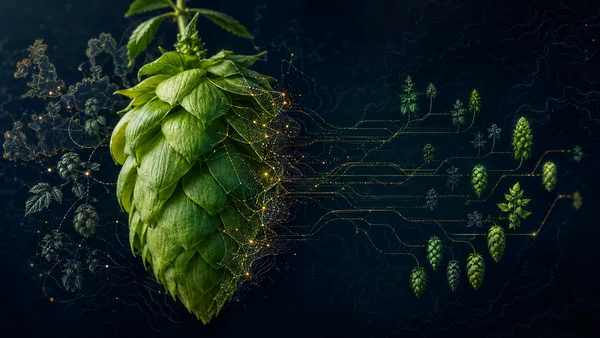
Place a handful of malted barley beside a handful of hops and the relationship is not self-evident. The barley is recognizably food. Chew a kernel and it is dry but sweet, something between cereal and toast. It belongs in the same imaginative family as bread, porridge, flour, and fields of grain. The hops are stranger. They look like small green paper lanterns and smell, depending on the variety, of cut grass, grapefruit peel, black pepper, cannabis, flowers, damp earth, or a pine box opened in an attic. Bite one and the experience becomes less culinary. The bitterness arrives with the authority of medicine.
There is no obvious reason these two plants should have become one of the great couples in the history of food. Barley has been eaten in soups, porridges, flatbreads, and stews. It can be roasted into a caffeine-free drink, malted into syrup, or fed to animals. Hops, by contrast, have never secured much of a place at the dinner table. Tender hop shoots have occasionally been eaten like asparagus, and the plant has wandered through folk medicine, but its famous purpose is remarkably narrow. Hops found beer and stayed there.
Today the pairing seems inevitable. Even people who know almost nothing about brewing know that beer contains hops. A label may show a green cone or boast of Cascade, Saaz, Citra, or Hallertau as if the hop were not merely an ingredient but beer’s coat of arms. Modern drinkers may argue over how much bitterness they want, but very few question how this peculiar flower acquired jurisdiction over fermented grain.
Beer, however, is completely possible without it. For most of beer’s extraordinarily long life, hops were absent. The marriage came late. It was resisted, taxed, regulated, and negotiated over centuries. Its success was not simply a matter of taste.
Malt made beer. Hops allowed beer to leave home.
Beer Before Its Familiar Taste
Beer is older than our neat definitions of it. Archaeologists have found evidence of fermented grain beverages thousands of years before the classical civilizations of Greece and Rome. The ingredients and methods varied widely: barley, wheat, millet, rice, tubers, fruit, honey, and other sources of starch or sugar could be brought together in drinks that occupy the broad territory we now call beer. Some were thick and porridge-like; some were strained; some were consumed communally through reeds. None needed to resemble the clear, carbonated pint that now supplies our mental picture.
At its most elemental, beer requires grain to be persuaded into giving up fermentable sugar. Germination does much of the invisible work. When barley is malted—allowed to begin sprouting and then dried—it develops enzymes capable of breaking its stored starch into sugars. Warm water gives those enzymes an opportunity to work; yeast takes over afterward and converts the resulting sugars into alcohol and carbon dioxide.
Barley became exceptionally valuable in this process not because it was the only grain capable of making beer, but because it was such a cooperative one. It malted reliably. Its enzyme content could convert a useful quantity of starch. Its husk remained around the kernel and, once crushed grain was soaked, helped form a natural filter bed through which sweet wort could be drawn. Wheat could make glorious beer, but its lack of husk made it a more difficult partner in the brewhouse. Barley seemed almost designed for the job, although design is the flattering name we give to a long history of agricultural selection and practical discovery.
What the grain did not provide was balance. Malted wort is sweet. Fermentation removes much of that sweetness, but early brewers still had reasons to add plants: for flavor, bitterness, preservation, perceived medicinal effects, ritual meaning, or simply because the local tradition said that this was how beer was made.
They had no shortage of possibilities. Medieval and earlier European beers could be seasoned with bog myrtle, yarrow, juniper, heather, wormwood, rosemary-like plants, resin, nettles, and other herbs. The word gruit eventually became associated with these older brewing mixtures, though it is misleading to imagine one universal recipe called gruit. The contents changed by region and period. A beer flavored by the plants of its surroundings could taste like a liquid expression of the landscape.
This older world of beer was probably far more diverse than ours in one sense and far less consistent in another. A drink made in one village might be immediately distinguishable from one made several valleys away. Seasonal plants changed. Household methods differed. Microorganisms living on vessels, tools, and in the brewhouse gave each fermentation its own population. Beer did not yet travel beneath the flag of a standardized flavor. It belonged first to the place where it was made.
The absence of hops did not make these drinks failed modern beers. They were complete beverages within their own traditions. That distinction matters. History often tells the story of a successful technology as if everything before it were waiting to be corrected. Unhopped beer was not standing in darkness, asking to be rescued by a flower.
The Unlikely Specialist
Wild hops grew across parts of Europe and Asia long before anyone recorded their use in a brew kettle. The plant climbs aggressively, sending long bines upward in search of light. The cones of the female plant contain lupulin glands: tiny reservoirs of resins and aromatic oils responsible for the bitterness and fragrance that brewers seek.
The earliest medieval documentary references are tantalizing rather than perfectly tidy. A ninth-century statute associated with Abbot Adalhard at Corbie discusses hops supplied for making beer, and later Carolingian records mention them as well. Whatever exact date one prefers for the first written appearance, hops did not suddenly conquer European brewing the moment someone dropped them into wort. Hopped and herb-seasoned beers coexisted for centuries.
That slow adoption makes sense. Raw hops are not immediately charming. Their bitterness must be extracted through boiling, and the brewer must learn how quantity, time, water, wort strength, and plant quality affect the result. Add too little or boil them poorly and their preservative advantage is diminished. Add too much and the beer may seem brutally bitter to a palate accustomed to sweeter ale. The eventual success of hopped beer was therefore not one discovery but a collection of techniques: cultivation, drying, storage, dosing, extended boiling, and repeated brewing on a commercial scale.
The chemistry behind the achievement would not be understood until much later. During the boil, alpha acids in hop resin are transformed into compounds that dissolve more readily into wort and produce a durable bitterness. Hops also inhibit many Gram-positive bacteria associated with beer spoilage. They do not sterilize beer, and medieval hopped beer was not microbiologically pristine, but hops could delay certain kinds of deterioration and give a barrel a better chance of arriving drinkable.
This is where a flower that was awkward as food became extraordinarily useful as infrastructure.
Beer Gets a Passport
Fresh local ale does not need to survive a journey. It can be brewed near the people who drink it, carried a short distance, and consumed before its weaknesses become apparent. A commercial beer must endure a harsher biography. It sits in a vessel. It warms and cools. It is rolled, lifted, carted, and placed aboard ships. Time becomes one of its ingredients.
Northern European brewing centers learned to make hopped beers that tolerated that biography better. By the later Middle Ages, towns such as Hamburg and Bremen were exporting beer into the Low Countries. Their barrels entered markets previously supplied by local brewers and disturbed more than local taste. Imported hopped beer threatened existing businesses and slipped awkwardly through systems built to tax traditional brewing materials.
The contest was not merely hopped beer against unhopped beer. It was traveling beer against beer that had never needed to travel.
A product that keeps can be made in greater quantities. It can be sold farther away. A brewer can become a specialist rather than someone making ale as one part of household labor. Equipment grows larger. Recipes become more repeatable because inconsistency becomes expensive. Merchants, municipal authorities, guilds, and rulers develop an interest in what enters the kettle and what leaves the city gates. The barrel turns a domestic craft into an industry.
Hops did not cause every part of this transformation by themselves. Urban growth, grain markets, shipping, taxation, improved equipment, and concentrated capital all mattered. Yet the preserving effect of hops fitted the new commercial world unusually well. The hop was not simply a seasoning riding inside the barrel. It helped make the barrel economically plausible.
This may explain the deepest reason hops and beer became inseparable. Beer selected hops because commerce selected beers that could endure.
The Politics Inside the Kettle
The older herbal mixtures also belonged to systems of power. In many medieval territories, the right to produce, distribute, or sell gruit functioned as a valuable privilege. A ruler, monastery, noble, bishop, or town government might control the sanctioned mixture or charge brewers for access to it. Since a great deal of beer was consumed, control over a required brewing material offered an efficient source of revenue.
Hops could disrupt this arrangement. A brewer purchasing hops through a different trade network—or growing them—might no longer need the proprietary mixture. Authorities did not always greet this innovation as progress. In the fourteenth century, imported hopped beers from northern German towns provoked restrictions in Holland, where they competed with local beer and complicated the collection of gruit-related revenues. Eventually hopped beer could be taxed too. Governments possess a reliable talent for incorporating successful rebellion into the tax code.
This political history has encouraged some wonderfully dramatic legends. One popular version casts gruit as the intoxicating, pagan, or Catholic drink of an older Europe and hops as the sober Protestant replacement. The chronology refuses to cooperate. Hopped beer was spreading through trade long before the Reformation, while gruit rights were held by a changing assortment of religious and secular powers. Hops themselves could even appear among the ingredients in regional herb mixtures. The real history is less like a clean religious war and more like most changes in food: uneven, local, opportunistic, and entangled with money.
What matters is that an ingredient can become powerful before anyone agrees that it tastes better. Hops offered brewers independence from some old controls while creating new agricultural regions, merchant networks, regulations, and taxes around themselves. The kettle was already political.
When Ale and Beer Were Different Things
England preserved the cultural friction in language. For a time, ale and beer did not operate as the loose synonyms they are today. Ale referred to the familiar English drink, traditionally made without hops; beer referred to the hopped product associated with immigrants and trade from the Low Countries.
The distinction contained a judgment. Hops were foreign. Their bitterness was suspicious. Complaints about their use should remind modern drinkers that flavor is not received by the tongue alone. We taste expectation, memory, status, and belonging. A person raised on sweet, fresh ale did not necessarily experience hopped beer as refreshing and properly balanced. He might experience it as someone ruining ale with a weed.
But the practical advantages were difficult to resist. Hopped brewing established itself in England, and the word beer expanded until it could contain nearly the whole family of fermented malt drinks. Ale survived as a term, but its old opposition to hops largely disappeared.
There is a useful lesson in that surrender. We often imagine taste driving the history of food: people prefer the delicious thing, so the delicious thing wins. Sometimes the order runs backward. A product succeeds because it keeps better, travels farther, satisfies the law, or earns more money. Its availability increases. New generations encounter its flavor earlier. What was once tolerated becomes familiar, and what becomes familiar acquires the dignity of tradition.
The bitterness of hops did not simply conquer Europe’s palate. Europe practiced it.
The Marriage Becomes Official
By 1516, when the rulers of Bavaria issued the ordinance now celebrated as the Reinheitsgebot, hops had crossed an important threshold. The decree restricted beer to barley, hops, and water. Yeast was not named, although brewers routinely carried fermentation from one batch to another without possessing a modern microbiological explanation for it.
The ordinance is often presented as an ancient vow of purity, a heroic defense of proper beer against corruption. Its historical purposes were more practical. It regulated prices and helped reserve wheat and rye for bread, directing brewers toward barley. It also applied to Bavaria, not to one unified Germany preserving an uncontested national recipe since the beginning of time. The modern mythology of the purity law is partly a later achievement of politics and marketing.
Still, myths become influential because they simplify a real inheritance. The ordinance placed barley and hops together not as an experiment but as the authorized constituents of beer. A relationship that had once seemed foreign, optional, and commercially disruptive could now be defended as purity itself.
Law has a peculiar ability to make historical choices look natural. Repeat the rule for long enough and the approved recipe retreats from history into common sense. Beer without hops begins to look like not quite beer, even though beer without hops is older than the rule, the state, and almost every institution that claimed authority over it.
The marriage had become official. The earlier suitors were gradually written out of the family album.
Learning to Love the Bitter Thing
If preservation explains why hops spread, it cannot entirely explain why they became beloved. Drinkers did more than accept their useful bitterness. Brewers learned to manipulate it, soften it, showcase it, and surround it with aroma.
Different hop-growing regions developed recognizable characters. Saaz became bound to the spicy refinement of Czech lager; Hallertau to the floral, herbal nobility of Bavaria; East Kent Goldings to English ale; Cascade to the grapefruit and pine signature of the American craft revival. The preservative became an instrument.
Brewers also learned that timing changed expression. Hops boiled for a long time contributed firm bitterness but surrendered much of their delicate aroma. Hops added late in the boil kept more fragrance. Hops steeped after the heat was turned off, or added to fermenting beer as a dry hop, supplied volatile aromas with comparatively little additional bitterness. One plant could occupy the bass line, the melody, or the solo.
That evolution reaches its comic extreme in the modern India pale ale, where hops can dominate the drink so completely that malt seems present mainly to provide the stage. The hop now advertises varieties, harvest years, farms, terroir, and experimental breeding programs. A plant adopted partly to keep beer from spoiling became the ingredient most likely to be prized for its fleeting freshness. Brewers work ferociously to preserve hop aroma from oxygen and age. The old preservative has become the fragile luxury.
This does not mean the marriage was a mistake or that older herbal beers were superior. It means successful traditions conceal their alternatives. Once a combination becomes canonical, we stop noticing how peculiar it is. Tomato and pasta, chocolate and sugar, coffee and milk: each pairing feels obvious after culture has performed it millions of times. Barley and hops may be the strangest of them because one partner supplies nearly all the food while the other supplies resistance.
One gives. The other refuses.
Beer lives in the tension.
What the Flower Did to the Grain
The next time hops enter a brew kettle, it is worth pausing before calling the smell simply “beer.” It is a historical smell: botanical, commercial, agricultural, and learned. Inside it are medieval gardens, municipal privileges, northern ports, wooden barrels, unfamiliar bitterness, laws about bread, generations of selective breeding, and the accumulated preferences of people who eventually forgot that beer could have gone another way.
Barley gave the drink its body, color, sugar, foam, and ancient connection to bread. Yeast supplied the transformation that no one could see but everyone could taste. Hops contributed bitterness and fragrance, but their greatest early gift may have been time. A beer that lasted longer could move farther. A beer that moved farther could become more consistent, more profitable, more regulated, and more culturally powerful. Eventually the ingredient that helped beer travel became part of beer’s identity wherever it arrived.
There is something almost moving in the narrowness of the hop’s achievement. Barley retained a life outside the brewhouse. It could return to the kitchen, the field, or the feeding trough. Hops found one great human use and pursued it so completely that the plant now seems to grow toward the kettle.
The marriage was not ordained by nature. It was arranged by preservation and commerce, formalized by law, and renewed through habit. Love came later.
And after centuries together, we can barely remember that the two were ever strangers.
Summary
Beer existed for thousands of years without hops. The marriage came late. It was resisted, taxed, regulated, and negotiated over centuries. Its success was not simply a matter of taste.
Seed Prompt
The Marriage of Strangers
SeedI am really interested about the history of how beer, something that is completely possible without hops, became “married” to hops. I do not know too many recipes outside of beer that use barley, and I know absolutely no other recipes that use hops. Let’s explore a fun article on this topic.
Intended lens: Beer history, material culture, and the commerce of taste
Created by: The Shelf editorial team
Sources
- Brewing & Beer—Archaeologically SpeakingLocated
Hannah Caroe / University of Oxford School of Archaeology
https://www.arch.ox.ac.uk/brewing-beer-archaeologically-speaking
Overview of Anglo-Saxon brewing plants, local variation, and keeping advantages associated with hops.
- Beer in the Middle Ages and the RenaissanceLocated
Richard W. Unger
2004
Primary secondary source for hopped brewing, urban trade, and the movement of north German beer into the Low Countries and England.
- From Herbal to Hopped Beer: The Displacement of Regional Herbal Beer Traditions by Commercial Export Brewing in Medieval EuropeLocated
Susan Verberg
2020
https://www.breweryhistory.com/journal/archive/183/index.html
Corrective to the claim that hops suddenly and universally replaced an inferior substance called gruit.
- The Three Breweries of St Gall Abbey and the Beer of the Carolingian EmpireLocated
Christian Berger
2021
Carolingian brewing context and the early documentary reference associated with Abbot Adalhard around 822.
- Belgium’s Historic Beer Diversity: Should We Raise a Pint to Institutions?Located
Eline Poelmans and Jason E. Taylor
2019
https://doi.org/10.1017/S1744137419000080
Institutional context for beer diversity and the historical use of gruit before hop dominance.
- 500 Year Anniversary of the Bavarian Beer Purity Law of 1516 (Reinheitsgebot)Located
Library of Congress
2016
Text and legal setting of the 1516 Bavarian ordinance.
Editorial Note
Sources listed in the Source Cabinet have been located for further reading. Full citation review has not been completed; treat historical claims with appropriate caution.
Other published essays in Brewing.

The Tide in the Glass
Why beer trends come and go, and why the old styles keep judging us.
The Map Inside the Pint
How hop varieties carried beer from Saaz to Citra—and how the home brewer can learn to taste the difference
Beer With a Thousand Faces
A light heroic history of civilization's oldest companion