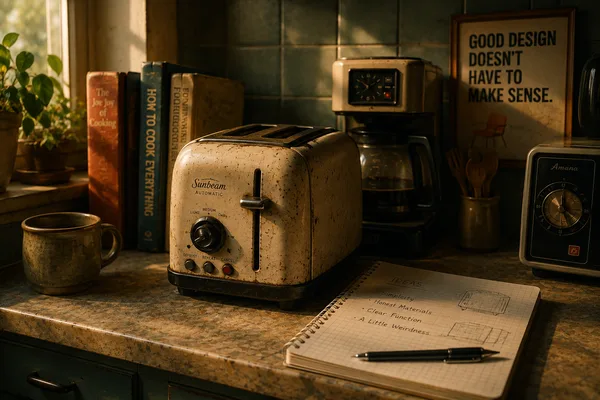
The Luxury of Ordinary Things
What can be removed?
- Craft
- pizza
- beer
Ordinary things become luxurious when craft, history, and attention meet inside them.
It is easy to assume that mastery leads toward complexity.
The accomplished chef must surely dream of impossible dishes. The legendary brewer must spend every weekend chasing stranger ingredients. The great songwriter, having learned every chord, must naturally want to use all of them. The filmmaker with a larger budget must want larger sets, larger explosions, larger worlds.
And sometimes, of course, that is true. There is pleasure in scale. There is pleasure in excess. There is even a kind of honesty in the human desire to see how far a thing can be pushed.
But something more interesting also happens.
The longer people devote themselves to a craft, the more often they seem to return to ordinary things.
Not because their imaginations have failed.
Because their standards have risen.
The beginner usually adds. More toppings, more hops, more instruments, more camera movement, more dialogue, more plot, more explanation. The beginner wants the work to announce itself. He wants evidence of effort to be visible from across the room.
The master begins asking a different question.
What can be removed?
This is one of the quiet paradoxes of craftsmanship. Simplicity is not where many disciplines begin. It is where they arrive after passing through complexity. The simple thing, once mastered, is no longer simple in the old sense. It becomes concentrated. It becomes exact. It becomes difficult to improve without damaging.
Pizza is a good place to begin because pizza is almost too familiar to notice.
On paper, it hardly sounds worthy of obsession. Flour, water, salt, yeast. Tomatoes, cheese, heat. A child understands the basic arrangement. A tired adult understands the appeal. A city block in America can contain three versions of it, all claiming to be good enough.
And yet pizza is one of the most demanding ordinary foods in the world.
There is nowhere for the dough to hide. If the fermentation is dull, the crust tells on you. If the sauce is too wet, the center collapses. If the cheese is careless, the whole thing becomes heavy. If the oven is too cool, the pizza bakes when it should leap. If the timing is off by a few minutes, the difference between crisp and dry, tender and gummy, alive and merely edible, announces itself immediately.
The casual eater sees a plain pizza.
The maker sees a chain of decisions.
How much yeast? How much salt? How long in the cold? How much gluten development? How thin should the sauce be? Should the cheese melt into the pie or remain as islands? Should the crust receive oil before the second bake, after, or not at all? How much char is flavor, and how much is just burn wearing a fashionable hat?
Nothing about the final object needs to become more complicated. In fact, the better the pizza gets, the less it seems to be trying. The craft disappears into the slice. You do not admire the engineering. You take another bite.
That is not a rejection of sophistication. It is sophistication doing its work invisibly.
Beer offers the same lesson, perhaps even more severely.
The early homebrewer is tempted by additions. More hops. More specialty malt. More fruit. More coffee. More vanilla. More alcohol. More ingredients that promise distinction before the brewer has earned clarity. This is understandable. Experimentation is part of learning. The imagination needs a playground before it develops judgment.
But ask an experienced brewer what is hard, and the answer often shifts away from extravagance. A giant barrel-aged stout may be technically demanding, but it also has places to hide. Roast can hide edges. Sweetness can soften mistakes. Alcohol can create drama. Adjuncts can distract the palate.
A pilsner has no such mercy.
A balanced pale ale has very little room for fraud.
A simple beer becomes a kind of examination. Was the fermentation clean? Is the bitterness sharp or harsh? Does the malt support the beer without weighing it down? Does the hop character speak clearly, or does it arrive as a green fog? Can the drinker finish one pint and genuinely want another?
Beer teaches one of the central lessons of ordinary luxury: the simpler form is often the less forgiving form.
This is why “ordinary” can be such a misleading word. It suggests something common, and therefore easy. But commonness does not remove difficulty. In some cases, it increases it. Everyone knows what pizza should be. Everyone knows what bread should be. Everyone knows what a good beer should feel like by the second sip. Familiarity gives the audience confidence. It also gives the maker fewer excuses.
A strange dish can confuse judgment. A familiar one cannot.
Music has its own version of this return.
A musician may spend years learning technique, harmony, production, arrangement, and tone. He may pass through noise, density, cleverness, and experiment. He may develop the ability to fill every available space. Then, after all that, the song begins to ask for less.
Bob Dylan remains the obvious example, not because his work is simple in thought, but because so much of its power survives reduction. A voice, a guitar, a progression, a line that sounds half-spoken and half-remembered. The recording does not need to behave like a cathedral because the song has its own architecture.
That is the test.
Can the thing survive without decoration?
In indie music, this question appears again and again. Beck can make dense, strange, layered records, full of collage and wit and production tricks, yet some of his strongest moments depend on dryness and space. Devendra Banhart often sounds as if the song arrived before the machinery did, as if someone had the good sense not to scare it away with too much polish. Fiona Apple is capable of rhythmic and harmonic intricacy, but her power often comes from preserving pressure rather than smoothing it out. She understands that polish can sometimes become a form of dishonesty.
The point is not that sparse music is better than elaborate music. That would be too easy, and false besides. The point is that great musicians learn what a song can bear. They know when an added sound deepens the work and when it merely decorates the ego of the person arranging it.
A beginner hears empty space and panics.
A master hears empty space and asks whether it is already saying something.
Film may be the clearest art form for this argument because film is so easily confused with scale. Larger budgets can buy more visible ambition: sets, effects, locations, costumes, armies of people moving under artificial weather. There is nothing inherently wrong with this. Spectacle is one of cinema’s native pleasures.
And yet many of the films that linger feel almost stubbornly modest.
Richard Linklater’s Slacker is built from drifting, talking, listening, and moving through a city. It does not seem interested in plot in the usual sense. It trusts attention instead. A person appears, speaks, vanishes. The camera moves on. The film begins to feel less like a story imposed upon a place and more like a place overheard.
That is a kind of discipline.
It takes confidence to let a film wander without letting it go slack. It takes judgment to make looseness feel shaped. A lesser version of the same idea would become shapeless almost immediately. Linklater’s achievement is that the film feels casual without being careless.
Wes Anderson’s Bottle Rocket is useful for a different reason. It is early, small, and comparatively plain next to the ornate visual worlds Anderson would later build. But the essential Anderson is already there: timing, friendship, failure, absurd confidence, emotional sincerity hiding inside artificial behavior. The later style became more elaborate, but the core was visible when the pieces were still modest.
This is important because simplicity is not always the opposite of style. Sometimes simplicity reveals the style before it acquires its furniture.
Even action films, at their best, depend on ordinary clarity beneath extraordinary events. Die Hard works not merely because things explode, but because its space is understandable. A man is trapped in a building. Floors matter. Elevators matter. Doors matter. Bare feet matter. The spectacle is anchored by simple physical problems. The Matrix, for all its philosophical and visual ambition, is still remembered through clean, graspable images: a choice between pills, a body dodging bullets, a hallway, a phone, a room where reality begins to bend.
The expensive thing still needs the simple thing.
Without the simple thing, spectacle becomes weather.
This is also true outside the arts.
A chair is ordinary until you sit in a bad one for too long. A notebook is ordinary until the paper fights the pen. A kitchen table is ordinary until it becomes the place where meals, bills, arguments, repairs, and late-night thinking all occur. A simple website is ordinary until every other website becomes a carnival of pop-ups, delays, nags, and buttons pretending to be helpful.
The best tools often disappear.
This does not mean they lack design. It means the design has matured past performance. The tool no longer begs to be admired. It lets the user continue living.
That, too, is a form of luxury.
Not luxury as expense. Not luxury as rarity. Not luxury as the velvet rope, the private room, the limited edition, the object whose primary function is to prove that it was obtained.
A deeper luxury exists in things that are difficult to exhaust.
A good pizza is difficult to exhaust. Not because one could eat it every hour of every day, but because the form keeps rewarding attention. The same is true of beer, bread, a three-chord song, a small film, a wooden table, a walk through a familiar neighborhood. Their value does not depend on novelty. They do not need to surprise us every time. They have another power: they remain available to deeper forms of noticing.
That may be the difference between novelty and durability.
Novelty asks to be noticed immediately.
Durability waits.
The ordinary thing survives fashion because it continues to answer some need beneath fashion. Bread survives. Beer survives. Songs survive. Rooms survive. Conversations survive. Pizza survives. Not because human beings lack imagination, but because imagination repeatedly returns to forms that can hold it.
The ordinary is not automatically profound. A bad slice of pizza is still a bad slice of pizza. A dull song does not become meaningful because someone played it on an acoustic guitar. A small film can be just as false as a large one. Simplicity alone is not enough.
This is where the sentimental version of the argument fails.
It is not enough to say, “appreciate simple things.” That turns the whole matter into a greeting card. The better claim is more demanding: ordinary things become luxurious when craft, history, and attention meet inside them.
The luxury is not that they are small.
The luxury is that they have been refined until smallness can carry weight.
This is why mastery so often involves restraint. Restraint is not the absence of ability. It is ability under command. The chef who does not add another ingredient may be showing more skill than the one who does. The brewer who refuses to bury a beer under hops may be taking the greater risk. The songwriter who leaves silence around a line may be trusting the line. The filmmaker who lets two people talk in a room may be betting everything on rhythm, performance, and truth.
The amateur adds because he fears the thing is not enough.
The master subtracts because he has learned what the thing is.
There is a kind of courage in that.
A plain pizza is not impressive in the usual way. A pale lager does not swagger. A quiet song does not seize the room by force. A modest film does not arrive with the cultural machinery of an event. But each can become unforgettable if made with enough care.
This is the luxury of ordinary things: not that they are easy to obtain, but that they are difficult to exhaust.
They keep opening.
The first pleasure is immediate. The slice tastes good. The beer is cold. The song catches. The movie charms. The chair supports the body. The notebook receives the pen.
But with more attention, another layer appears. Technique. Judgment. Timing. Materials. Restraint. Tradition. The decisions that were not made. The flour that fermented long enough. The hop that was not added. The instrument that remained silent. The camera that did not move. The scene that trusted a pause.
At the beginning of taste, we often want the extraordinary because we can recognize it quickly. It announces itself. It gives us something to point at.
But as taste develops, recognition becomes quieter. We begin to admire the thing that does not need to announce itself. We notice the crust. The balance. The negative space. The clean ending. The chair at the right height. The film that knew when to stop.
This is not a rejection of ambition. It may be one of ambition’s final forms.
To make something ordinary very well is to enter a long conversation with everyone who has ever attempted it. The pizzaiolo is not merely making dinner. The brewer is not merely making alcohol. The songwriter is not merely arranging sound. Each is working inside a form so familiar that failure has nowhere to hide and success may be mistaken for ease.
That is why the ordinary deserves more respect than it usually receives.
Not reverence. Reverence would ruin it.
Respect.
The respect due to things that have carried human attention for a very long time.
Perhaps mastery does not end with escaping the ordinary. Perhaps mastery ends with returning to it differently. The same slice, the same pint, the same song, the same room, the same afternoon light through the window—but now seen with better eyes.
The ordinary was never empty.
We were simply not finished learning how to see it.
Summary
A cross-disciplinary essay on pizza, beer, music, and film — arguing that the luxury of ordinary things is not ease but the difficulty of exhausting them once craft has made smallness carry weight.
Seed Prompt
The Luxury of Ordinary Things
SeedWrite a warm, cross-disciplinary essay on how mastery returns to ordinary things after passing through complexity. Use pizza, beer, music, and film to argue that simplicity is often where crafts arrive, not where they begin — and that the luxury of ordinary things is difficulty without exhaustion. Accessible, not academic. No fake citations.
Intended lens: Craft, pizza, beer, music, film, mastery, restraint, ordinary life
Created by: The Shelf editorial team
Sources
No verified sources yet. This essay is in an early stage and has not been through citation review.
Editorial Note
This essay has not been through citation review. Sources will appear in the Source Cabinet once located and verified.
Other published essays in Ordinary Philosophy.